There is a version of the American immigrant business story that everyone knows: the restaurant that fills up on Diwali, the grocery store where the whole neighbourhood does its weekend run, the realtor who sold half the Telugu families in the subdivision their first house. Word of mouth built all of it, and word of mouth still works.
The problem is that word of mouth has moved. It happens now inside a WhatsApp group, a community Facebook page, a Google review thread, and a 20-second reel. And the businesses capturing it are not always the best ones — they are the ones that show up when somebody searches.
This is a practical playbook for Indian-owned businesses in the US in 2026: restaurants and tiffin services, grocery stores, realtors and loan officers, CPAs, insurance agents, travel and visa consultants, tutoring centres, salons, event planners, IT staffing firms and clinics. Written by a team that builds for these businesses across Dallas, New Jersey, the Bay Area and nine other metros.
The market you are actually in
Telugu is the fastest-growing language in the United States — roughly 320,000 speakers in 2016, about 1.23 million by 2024, according to reporting on Census/ACS data. California, Texas and New Jersey lead, with heavy concentrations around Irving and Frisco, Edison and Jersey City, Fremont and Santa Clara, Naperville, Ashburn, Sugar Land and Alpharetta.
That growth is the opportunity and the threat at once. The community around you is bigger every year — and so is the number of businesses competing for it. Ten years ago being the only Telugu-speaking realtor in your suburb was a moat. Today there are eleven, they all post on the same community group, and the one who gets the call is the one whose name comes up first when someone searches.
Mistake one: the business lives entirely inside WhatsApp
The most common setup we see is a business running on a personal WhatsApp number, a Facebook group post, and a phone that rings. It works — until it doesn't scale, and until the customer who is new to the area cannot find you at all because they are not in the group yet.
New arrivals — the H-1B family that landed last month, the student starting at UT Dallas, the couple that just moved from Seattle to Frisco — do not have your number. They search. If you are not there, you are invisible to every single new customer entering your market, which is precisely the fastest-growing segment you have.
The fix is not to abandon WhatsApp. It is to add a findable front door — a real website and a complete Google Business Profile — that feeds into the WhatsApp conversation you are already good at. Keep the personal relationship. Just stop being undiscoverable.
Mistake two: an English-only presence for a bilingual customer base
Your customers speak English perfectly well. That is not the point. The point is that "we speak Telugu," "Hindi spoken here," "we understand H-1B and green card timelines," "we file for NRIs" are trust signals, and trust is what makes somebody pick a professional for their taxes, their mortgage or their child's education.
A realtor's page that says "helping Telugu families buy their first home in Frisco since 2017" converts a completely different way than "experienced real estate professional." Same person, same service. One of them sounds like home.
Say it explicitly on the website, in the Google profile description, in the reviews you ask for, and in your ad copy. This is the single cheapest conversion improvement available to an Indian-owned business in the US, and most skip it out of a vague sense that it narrows the market. It does not narrow it. It wins it.
Mistake three: no online ordering, booking or payment
American consumer behaviour is now firmly self-service. A customer who has to call during business hours to book a table, place a tiffin order, schedule a consultation or pay an invoice is a customer with three chances to change their mind.
What to add, by business type:
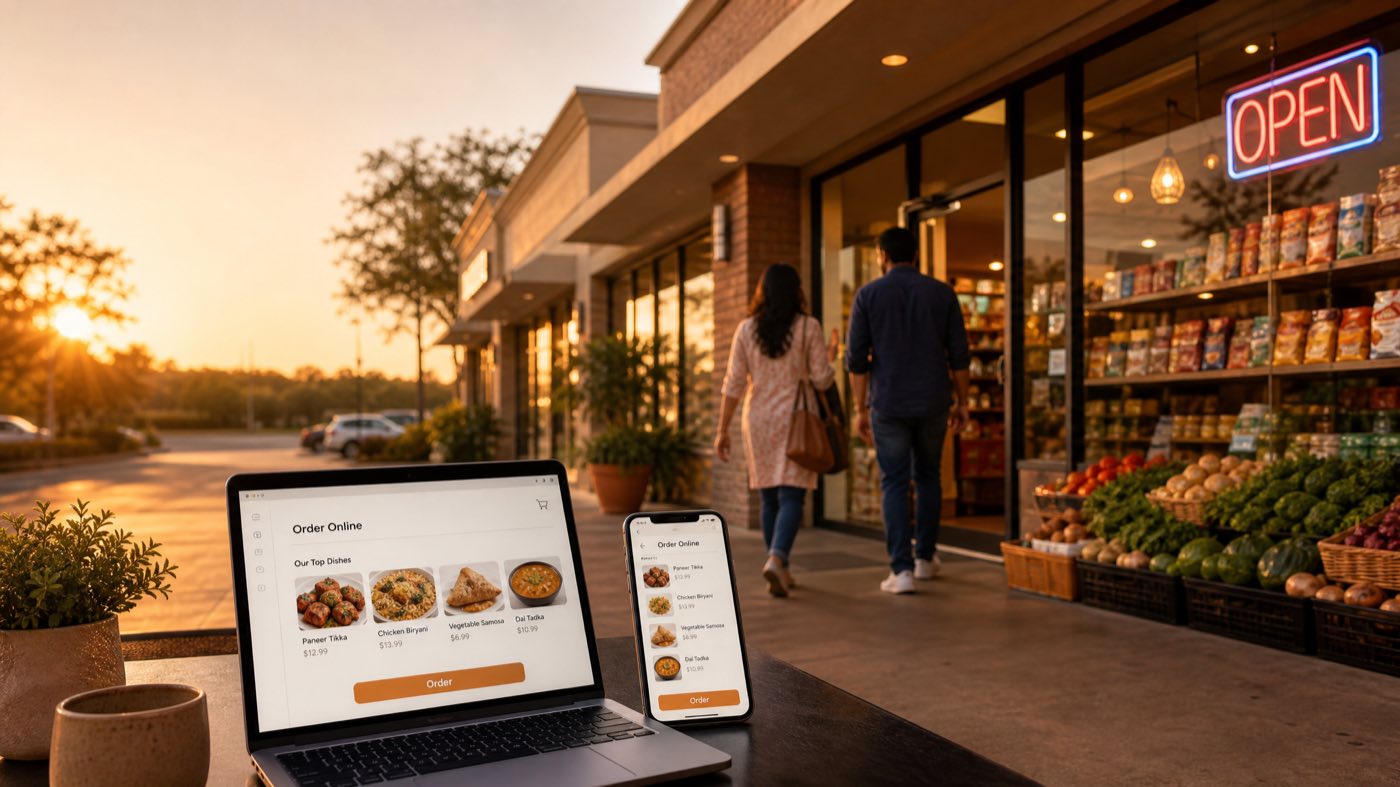
- Restaurants and tiffin services — direct online ordering on your own site. Third-party delivery apps take 15–30% and own the customer relationship; your own ordering page costs a flat build fee and the customer stays yours. Weekly tiffin subscriptions in particular should never be running through a delivery app. See what we build for US restaurants.
- Grocery and sweet shops — a simple catalogue with pickup and local delivery. You do not need a full Amazon. You need festival pre-orders, a sweets menu, and a way to take payment before Diwali week rather than during it. Costs are in our US e-commerce cost guide.
- Realtors, CPAs, insurance and visa consultants — a booking calendar and a lead form that captures situation, timeline and phone. Consultation-driven businesses lose most leads to slow follow-up, not to price. Real estate agent sites are a specific build.
- Salons, spas, tutoring and fitness — online scheduling with reminders. No-shows drop measurably the moment reminders go out automatically.
- Clinics and dental practices — appointment requests plus insurance information up front. See medical clinics and dental practices.
Mistake four: ignoring Google reviews while collecting compliments
Community businesses run on reputation, and yet the reputation usually lives in people's heads and in group chats where Google cannot see it. Meanwhile a single unhappy customer from two years ago sits at the top of your profile with three sentences of damage.
Build the habit: ask at the moment the customer is happiest, send a direct review link by text, reply to every review, and never argue in public. If most of your reviews are from community members who mention the language, the food, the specific suburb — that becomes powerful proof for the next person searching, and it also feeds the local ranking signals that decide who shows up in the map results at all. We break the whole mechanism down in our guide to winning the Google Map Pack.
Mistake five: no video, in a market that now runs on video
The community you sell to is on Instagram and YouTube constantly. A restaurant that posts a 20-second reel of biryani coming out of the pot on Friday afternoon is not doing branding — it is doing demand generation for Friday dinner. A realtor posting a 30-second walkthrough of a Frisco listing gets seen by exactly the people relocating to Frisco.
Most owners don't skip video because they doubt it works. They skip it because producing it weekly is genuinely hard while also running the business. That is what our AI video service is for — $29 per video, or $199/month for a steady content engine, from footage you shoot on your phone in five minutes.
The build order that actually works
You do not need everything at once. In our experience with US community businesses, this sequence produces revenue fastest:
- Google Business Profile, completed properly. Free, takes an afternoon, and for a local business it is usually the single largest source of new customers. Correct category, real photos, services listed, hours accurate, language mentioned.
- A real website with the one action you want. Order, book, call or enquire — one primary action, on every screen. Our US website packages start at $169 for a single landing page and $499 for a full business site.
- A review system. Automated ask, direct link, every reply answered.
- Local SEO for the suburbs you serve. "Indian grocery store in Irving," "Telugu CPA near Edison," "South Indian restaurant Naperville." These are low-competition, high-intent searches and they are yours to take. Local SEO runs $299/month.
- Content and video, weekly. Once the first four are live and converting.
- An app — only when you have repeat customers. Tiffin subscriptions, tutoring centres, gyms and grocery loyalty genuinely benefit. A one-time-purchase business does not. App costs are here, and MVPs start at $1,049.
What this should cost you
This is where most community businesses get burned. A US agency quoting an Indian restaurant $6,000 for a website and $2,500/month for marketing is not unusual, and the work delivered is frequently a template with the owner's photos dropped in.
Our published US pricing exists to end that negotiation: $169 landing page, $499 business website, $1,249 for e-commerce, $299/month local SEO, $499/month growth SEO, $29 per video. Every number is on our US cost guides, and the reasoning behind how we can charge that is in the offshore vs US agency comparison. Nobody has to ask us for a quote to know what things cost.
One warning worth its own sentence: be careful with the "$99/month website" offers that circulate in community groups. They are almost always a rented template on a platform you do not control, and when you stop paying, the site disappears — along with the SEO you built on it. We compare that model honestly in website builders vs custom.
We work city by city
Because the community, the suburbs and the competition are different in every metro, we build metro-specific: Dallas–Fort Worth, New Jersey, the Bay Area, Chicago, Atlanta, Houston, Seattle, Northern Virginia and four more metros.
Frequently asked questions
Should my website be in Telugu or Hindi?
Almost always no — build in English and state that you speak Telugu or Hindi. Your customers search in English, including community members, so an English site ranks and a translated one usually does not. The exception is a specific page for a service where the language itself is the product, like Telugu classes or a cultural association.
I already get all my business from WhatsApp groups. Why do I need a website?
Because every family that moves into your area next month is not in that group yet, and they will search before they ask. A website also gives the group something to forward. The two work together — the site is where the referral lands and gets convinced.
How long before I see new customers?
Google Business Profile improvements can show up in two to six weeks. A new website starts converting the traffic you already have immediately. Local SEO for competitive suburb searches typically takes three to four months to hold position. Anyone promising faster in a metro like Dallas or the Bay Area is guessing.
Do I need an app for my restaurant or grocery store?
Usually not at the start. An app earns its cost when customers come back weekly and you want subscriptions, loyalty or reordering — tiffin services and grocery stores are the two cases where it genuinely pays. For everyone else, a fast mobile website does the same job for a fraction of the price.
You are based in India. How does that work for a US business?
We have shipped for US clients for years and work on your hours — calls in your morning or evening, work delivered overnight your time. Pricing is in USD, billing is straightforward, and you talk to the people building the thing rather than an account manager. The full picture, including where offshore is genuinely the wrong choice, is in our offshore vs US agency guide.
Start with one thing
If you do nothing else this month: complete your Google Business Profile and text your last thirty happy customers a review link. It is free, it takes an afternoon, and for most community businesses it produces more new customers than anything else on this list.
When you are ready for the website, the ordering system, the SEO or the video — we build for Indian-owned businesses across the US every week. See what we do for Telugu- and Hindi-speaking business owners, or message us on WhatsApp or team@manastudio.in. Tell us your business and your city; we will tell you what we would build first and what it would cost.