Mana Studio did an incredible job building the website for Dwarka Packers and Movers! Special thanks to Vamsi garu and his brother, who were extremely responsive, supportive, and patient throughout the entire process. They understood all our requirements perfectly and delivered a smooth, professional, and high-quality website. Highly recommend their services to anyone looking for top-notch web development!"
Web development
Custom web development for businesses that have outgrown a brochure site
Custom web applications, dashboards, portals and business websites built on React, Next.js and Node.js — scoped in writing, delivered in stages, and handed over with the code, the hosting and the logins in your name.
A written scope and a fixed number before any work starts — not a discovery retainer.
Quick answer
What does custom web development cost in India, and how long does it take?
Mana Studio builds custom web applications, dashboards, customer portals, ecommerce stores and business websites on React, Next.js, Node.js and MongoDB. On the India price list a business website is ₹25,000 and an ecommerce or custom-logic build starts at ₹60,000; application work above that is quoted to scope after a discovery call, as a fixed number against a written scope naming what is included and what is explicitly excluded. A business website takes one to two weeks, a focused application MVP four to eight weeks, and larger platforms are delivered in stages so there is working software early rather than a demo at the end. The repository, hosting account, domain, database and every API key are handed over in the client's name at launch. Mana Studio is based in Warangal, Telangana, India, works with clients in India, the United States, the United Kingdom and the UAE in English, Telugu and Hindi, and replies to enquiries within one business day.
Last reviewed
- Business website
- ₹25,000 (India price list)
- Ecommerce / custom logic
- From ₹60,000
- Applications
- Quoted to scope after a discovery call
- Timeline
- 1–2 weeks for a website; 4–8 weeks for an MVP
- Stack
- React, Next.js, Node.js, MongoDB
- You own
- Code, servers, domain and every key, in your name
Most web projects do not fail on design. They fail because nobody wrote down what the thing was supposed to do before somebody started building it, and six weeks in the scope is three times what was quoted. We work the other way round: a short discovery call, a written scope with what is in and what is explicitly out, a fixed number, then staged delivery so you see working software early rather than a demo at the end.
The work ranges from a marketing site that has to load fast and rank, through customer portals and internal dashboards, to full web applications with authentication, roles, payments and a real database behind them. The stack is deliberately boring and well-supported — React and Next.js on the front, Node.js and MongoDB behind it — because the point is a codebase your next developer can pick up, not one only we can maintain.
The sentence this usually starts with
Nobody wakes up wanting web development. They want one of these six things to stop being true.
“It takes too long to load on a phone.”
Almost always images, third-party scripts and a theme doing work the page never needed. The fix is a rebuild on Next.js with static generation and image optimisation, and Core Web Vitals treated as an acceptance criterion rather than a phase-two ticket.
“It looks fine, but the phone never rings.”
Usually a structure problem rather than a design one — no obvious next step on any screen, an enquiry form nobody can finish on a phone, and no click-to-call or WhatsApp path. That is a rebuild of the conversion paths, not of the logo.
“We have outgrown the website.”
The business now has customers who need accounts, orders that need tracking, or data that belongs in a database instead of a form email. That is the point where a website becomes a web application, and where the budget and timeline change.
“The work runs on a spreadsheet four people email around.”
The most common internal build we do: one place for the records, roles so each person sees only their part, and a history of who changed what. It usually replaces the spreadsheet and the WhatsApp group at the same time.
“Two systems we already pay for do not talk to each other.”
Payment gateways, the WhatsApp Business API, CRMs, ERPs, delivery partners and analytics tools all publish APIs. The work is the integration layer between them, and behaving sensibly when one of them is down.
“The developer stopped replying.”
We start with a paid audit of the existing code, hosting and accounts, then give a straight answer on whether continuing is cheaper than rebuilding. Sometimes it is not, and that is better to hear at the audit stage than three months in.
What we build
Custom web applications
Multi-user applications with authentication, roles and permissions, a real database, and an admin side for the people who run the business. Built as an MVP first so there is something usable before the budget is gone.
Dashboards and internal portals
The screens your team actually works in — order queues, reporting, approvals, customer records. Usually the thing replacing a spreadsheet that four people email around.
Business websites built to rank
Next.js sites with on-page SEO, schema and sitemaps generated at build time rather than bolted on, and Core Web Vitals treated as a requirement instead of a nice-to-have.
Ecommerce and checkout
Catalogue, cart and payment with UPI, Razorpay or PhonePe, plus the order and inventory side the storefront is useless without.
APIs and third-party integrations
REST APIs for your own apps, and the connections to everything else — payment gateways, WhatsApp Business API, CRMs, ERPs, delivery partners, analytics.
Rebuilds and rescues
Slow sites, half-finished projects, and platforms whose original developer has disappeared. We audit first and tell you honestly whether it is worth saving.
Website, or web application?
The two words get used interchangeably and they are not the same product, the same timeline or the same budget. This is the split we work to, and where each one lives on this site.
| If this is the situation | What you actually need | Why |
|---|---|---|
| You need to be findable on Google and get enquiries by phone or WhatsApp | Business website | Content, speed and conversion paths. No logins, no database of your own — and package prices are published. |
| You sell products online and need payment, orders and stock | Ecommerce store | A catalogue plus a back office. The storefront is the smaller half of the build. |
| Customers log in and see data that belongs only to them | Web application | Authentication, roles and a real database — the point at which a website stops being enough. |
| Your own team works in it every day: orders, approvals, reporting | Internal dashboard or portal | Built for speed of data entry rather than for visitors. Usually replaces a spreadsheet. |
| Several kinds of user, each allowed to do different things | Custom web application | Permissions and business rules are the build. This is the one to scope in writing before anyone designs a screen. |
| The software itself is the product and customers subscribe to it | SaaS platform | Multi-tenancy, billing and onboarding sit on top of the application. |
| You want a home-screen icon and push notifications, without the app stores | Progressive web app | A website that installs. It keeps its URLs and stays indexable, which a native app cannot. |
| You already have a site and it is slow, dated or nobody can maintain it | Rebuild, not a new build | The redirect map matters more than the design. Audit first, then decide. |
Rows three to five are what this page is mainly about. If you are on row one, the local website pages have published package prices and a shorter timeline — start there instead.
The stack we work in
Mainstream, well-supported technology — chosen so your next developer can pick the project up, not so we are the only ones who can maintain it.
Front end
- React
- Next.js
- TypeScript
- Tailwind CSS
- PWA
Back end
- Node.js
- REST APIs
- MongoDB
- Appwrite
Infrastructure
- AWS (EC2, S3)
- Nginx
- PM2
- GitHub Actions CI/CD
Integrations
- Razorpay
- PhonePe
- UPI
- WhatsApp Business API
- Google Analytics 4
- Search Console
Customer portals and client logins
A large share of the application work here is the same shape: your customers, or your franchisees, or your field staff, log in and see only what belongs to them. It is worth naming because people search for it and rarely recognise it as “web development”.
Accounts and role-based access
Who can see what is the build. Customers, staff, managers and branch heads each get a different view of the same data, and every role that behaves differently is its own set of rules to build and test.
Documents, invoices and statements
The most common reason a portal gets commissioned. Customers pull their own invoices, orders and certificates instead of emailing somebody to find them.
Status without a phone call
Order, job, ticket or application status, visible to the person waiting on it. This is where the support-call reduction actually comes from.
Two-factor and session control
Once real customer data is behind a login, authentication stops being a checkbox. MFA, session expiry and an audit trail of who saw what.
Plugged into what you already run
A portal is usually a window onto an existing CRM, ERP or billing system rather than a new store of truth. The integration is most of the work.
Self-service that reduces inbound
Raise a request, upload a document, update details. Every one of these that works is a call your team does not take.
Built to be found, not optimised afterwards
Technical SEO is cheap while the code is being written and expensive once it is not. These are part of the build rather than a separate line item quoted later.
Semantic HTML, one H1 per page
Headings that describe the content in order, real landmarks and real links — the structure crawlers and screen readers both depend on.
Metadata and schema at build time
Titles, descriptions, Open Graph and schema.org JSON-LD generated from each page’s own data, so a new page cannot ship without them.
Server-rendered, indexable URLs
Every page returns its content without running JavaScript first. Answer engines in particular do not run yours.
Sitemap, robots and canonicals
Generated from the routes that actually exist rather than maintained by hand, with one canonical URL per page.
Core Web Vitals as acceptance criteria
LCP, INP and CLS measured before launch rather than after. Images optimised, fonts preloaded, JavaScript kept off the critical path.
Search Console and GA4 on handover day
Both configured and verified in your accounts at launch, so the data starts on day one instead of month three.
A redirect map on every rebuild
Old URLs mapped one by one to their new destinations before go-live. This is what decides whether a relaunch keeps its traffic.
Internal linking that is designed
Related pages linked with descriptive anchors, so the shape of the site says what the site is about.
None of this is a promise about rankings, and anyone offering you one is guessing. It is the groundwork that has to exist before content and links can do anything at all.
How we work
How a project runs
Scope
A call about what the software has to do and who uses it, then a written scope: features in, features out, timeline, fixed price. You can take that document to another studio — that is the point of writing it down.
Design and data model
Screens and the data structure behind them, agreed before code. Changing a data model in week six is where budgets die.
Staged build
Delivered in working slices on a staging URL you can log into. You see progress every week, not a reveal at the end.
Launch and handover
Deployment, analytics and Search Console configured, and every account, key and repository transferred into your name. Support is a separate agreement, never a lock-in.
What it costs
Application work is quoted to scope after the discovery call — the honest answer is that a five-screen internal tool and a multi-tenant platform are not the same product. Where a package price is published, it is published in full:
Web work we have shipped
Real client projects, with the technologies actually used on each one.
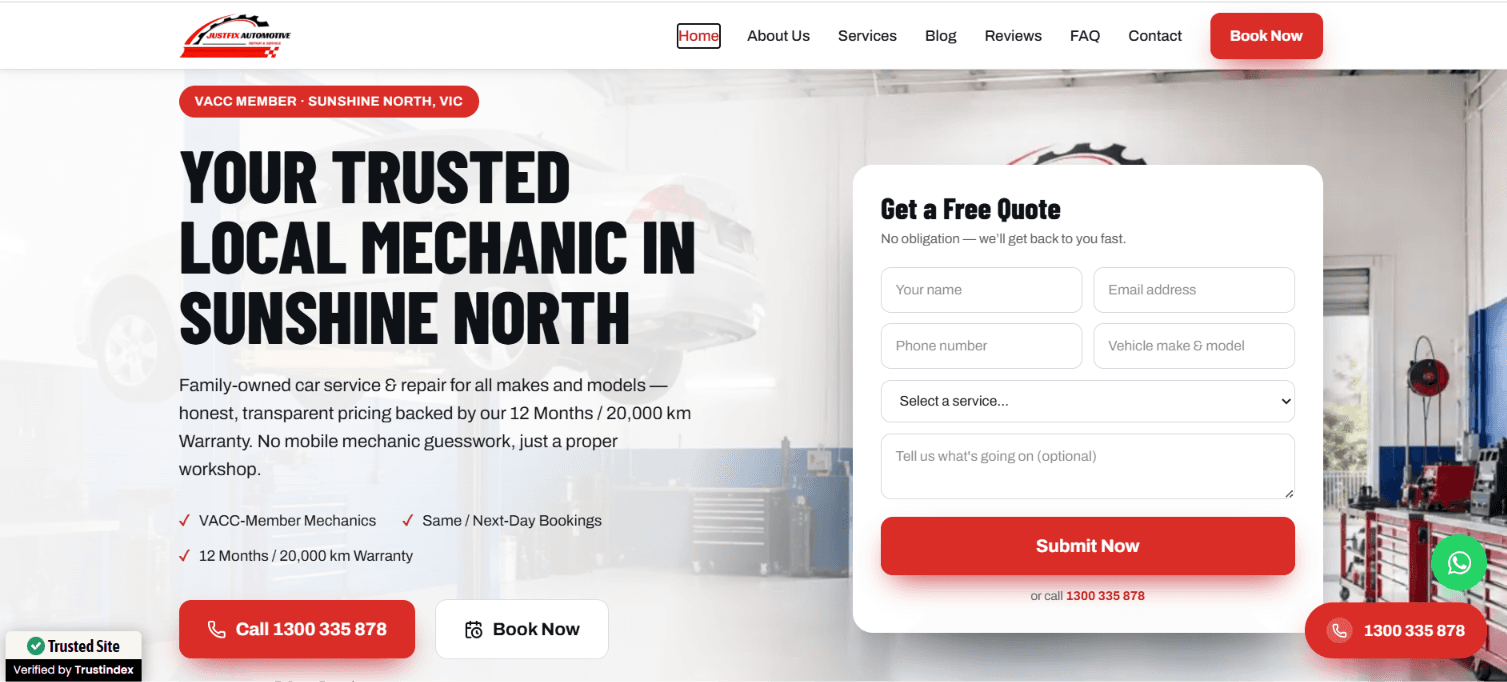
Car Service
JustFix Automotive
Designed and built a fast, user-friendly website for JustFix Automotive, a trusted mechanic workshop in Sunshine North, VIC. We executed a comprehensive on-page and technical SEO strategy optimizing site speed, local schema, and service-page architecture—to boost search rankings, capture high-intent local traffic, and drive online service bookings.
NEXT JS · HOSTING · TAILWIND · MONGODB

E-commerce
Rami Silks
Full-stack e-commerce platform for traditional Indian clothing with AWS integration and advanced analytics
Next.js · Node.js · MongoDB · AWS S3

Job Portal
Sarkari Job Samachar
Comprehensive job portal for government job seekers with real-time updates and notifications
Next.js · Appwrite · SEO · Content Management

logistics website
Dwaraka Packers and Movers
A modern, SEO-optimized website designed and developed by Mana Studio for a professional packers and movers company. From UI/UX design to full-stack development, we built a fast, mobile-friendly, and conversion-focused website that helps generate leads, build customer trust, and strengthen the brand's online presence.
Next.js React.js JavaScript (ES6+) HTML5 CSS3
What clients say about this work
“Mana Studio developed a professional website for Aadhya Packers and Movers. The new website gives our customers clear information about our services and branches, making our business look more professional and helping customers contact us easily.”
Web Development by industry
The sectors we have shipped work in, and what changes about the build in each one.
Sources & further reading
The primary documentation behind the claims on this page.
Web Development by city
The same web development team, priced and delivered locally in each city.
- Talk to us about website designing company in Warangal
- Website Development in Hanumakonda
- Website Development in Kazipet
- Website development company in Karimnagar explained
- Website Development in Siddipet
- Website Development in Hyderabad
- Website Development in Vijayawada
- Website Development in Visakhapatnam
Related services
SaaS developmentWhen the application is the product you sell.Custom software developmentInternal systems, dashboards and business platforms.Ecommerce developmentOnline stores with UPI and Razorpay checkout.API & integration servicesPayments, WhatsApp Business API, CRM and ERP connections.Website redesignWhen the site already exists and the rankings have to survive the rebuild.Affordable website design in Warangal & HyderabadThe local small-business page, with published ₹ packages and Telugu support.
Web Development — frequently asked questions
How much does custom web development cost in India?
It depends almost entirely on scope, so we quote after a discovery call rather than publishing a single number for "a web app". For reference, the packaged end is published: a business website is ₹25,000 and an ecommerce or custom-logic build starts at ₹60,000 on the India price list. Application work above that is quoted as a fixed price against a written scope before anything starts.
How long does a web application take to build?
A focused MVP is typically 4–8 weeks. A business website is 1–2 weeks. A larger platform with several user roles, payments and integrations runs longer and is delivered in stages, so you have something working well before the final one.
Why React and Next.js rather than WordPress?
For a brochure site, WordPress is often the right answer and we will say so. Next.js earns its place when the site needs to be genuinely fast, when there is application logic behind it, or when hundreds of pages have to be generated from data — which is where a plugin stack starts fighting you. We build in both; the recommendation follows the project.
What is the difference between a website and a web application?
A website presents information — pages, content and a way to get in touch, the same for everyone who visits. A web application does work: people log in, it stores their data, it enforces rules about who is allowed to do what, and what you see depends on who you are. The practical test is whether anybody needs an account. If nobody does, it is a website. The moment somebody does, the budget, the timeline and the way the project has to be run all change.
Can you integrate payment gateways and WhatsApp?
Yes — Razorpay, PhonePe and UPI for payments, and the WhatsApp Business API for notifications and enquiry handling. The integration work is more than the happy path: what takes the time is order state for failed, pending and refunded payments, and behaving sensibly when a third-party service is down. CRMs, ERPs, delivery partners and analytics tools are connected the same way, over their published APIs.
Can you rebuild an existing site without losing its Google rankings?
That is the main risk in a rebuild, and it is planned for rather than hoped for: every existing URL is crawled and mapped to its new destination before launch, and titles, headings, structured data and internal links are rebuilt deliberately instead of regenerated by a theme. Rankings can still move for reasons nobody controls, so no one should promise otherwise — but the avoidable cause, URLs that changed without redirects, is avoided. Website redesign is written up as a service of its own.
Do you work with businesses outside Telangana?
Yes. The team is remote and distributed across India, with the business based in Warangal. Clients are in India, the United States, the United Kingdom and the UAE, and the entire process runs over calls, WhatsApp and a shared staging environment.
Who owns the code?
You do, completely. The repository, the hosting account, the domain, the database and every API key are handed over in your name at launch. Nothing we build stops working if you stop working with us, and there is no platform fee to us.
Can you take over a project someone else started?
Often, yes. We start with a paid audit of the existing codebase and give you a straight answer on whether continuing is cheaper than rebuilding. Sometimes it is not, and we would rather tell you that at the audit stage than three months in.
Get a free project plan
A written scope and a fixed number before any work starts — not a discovery retainer.
Reference
Terms and guides worth reading first
Plain definitions and walkthroughs from our own reference library. No sign-up, no gate.
- Headless CMSA headless CMS stores and edits content but doesn't render the website
- Progressive EnhancementProgressive enhancement means building so the core content and functions work with minimal technology, then layering on improvements for capable browsers
- Web ApplicationA web application is software that runs in a browser and does work
- Technical DebtTechnical debt is the accumulated cost of shortcuts taken to ship faster
- Core Web VitalsCore Web Vitals are Google's three measures of page experience: Largest Contentful Paint (loading), Interaction to Next Paint (responsiveness) and Cumulative Layout Shift (visual stability)
- Largest Contentful Paint (LCP)LCP measures how long until the largest visible element
Guides
Best Web Development Company in India To Turn a Spreadsheet Business Into a System
A website and a web application get quoted in the same breath and they are not the same job. A website tells people what you do and gets them to call or message. A web application does work: someone logs in, it stores their data, and what a person sees depends on who they are. The confusion costs money in both directions, because a business that needed a website ends up paying for logins and roles it never uses, and a business that needed a login system gets a pretty homepage with a contact form bolted where the database should be.
This page is written for the second case: the point where a spreadsheet four people email around, or a WhatsApp group where the real coordination happens, has quietly become the way the business runs. That is a web application problem, and it has its own budget, timeline and set of questions worth asking before you sign anything.
The moment a website stops being enough
There is usually a specific trigger. Customers start asking for accounts so they can see their own order history instead of emailing you. Two people editing the same spreadsheet start overwriting each other's changes. A report that used to take ten minutes to assemble by hand now takes an afternoon because the data lives in four places.
None of that is a design problem, so a new template will not fix it. It is a data model and permissions problem, and the fix is a real database with roles: your staff see their queue, your customers see only their own records, and a change gets logged instead of silently overwritten.
What actually goes into the build
The stack is React and Next.js on the front end, Node.js and MongoDB behind it. That combination is chosen for a reason that has nothing to do with trend: it is well-supported enough that your next developer, if you ever change studios, can pick up the codebase without learning something exotic first.
- Authentication, roles and permissions built into the data model, not patched on with query filters later
- A real database behind the screens, replacing whatever spreadsheet or email chain is currently load-bearing
- An admin side for the people who run the business, not just a public front end
- REST APIs for your own apps and for the third-party systems you already pay for
- Payment integration through Razorpay, PhonePe or UPI where the build needs it
- Semantic HTML, generated metadata and schema, and Core Web Vitals treated as an acceptance criterion
What it costs, and what changes the number
A business website with no login system is the cheapest and fastest thing on this page, and it is priced on the local Hyderabad packages, not here, because that work has a different shape entirely. A web application is quoted after a discovery call, because a five-screen internal tool and a multi-tenant platform are not the same product and no honest studio prices them the same way before understanding the scope.
What moves the number: how many kinds of user there are, how much of the process needs approval steps or history logging, and how many outside systems it has to talk to. A project that is mostly one user type doing one job is a fraction of the cost of one with five roles and three integrations, and that difference should show up in the written scope, not as a surprise invoice in week six.
When a rebuild is cheaper than a repair
If the previous developer has stopped replying, or the code is a black box nobody understands, the honest first step is a paid audit rather than a quote for new features. We look at the existing codebase, the hosting and the accounts, and give a straight answer on whether continuing is cheaper than starting over. Sometimes the existing system is worth saving. Sometimes it is not, and hearing that at the audit stage costs far less than hearing it three months into a doomed patch job.
When this is not the right spend
If nobody in your business needs to log in and see data that belongs only to them, you do not need a web application, and paying for authentication and roles you will never use is money spent on the wrong product. That case is a business website, and it belongs on the local Hyderabad or Warangal price list, not this page.
If the actual problem is that your existing site loads slowly or nobody finds it on Google, that is usually a rebuild-for-speed-and-search problem, not a new-features problem, and a redesign scoped around Core Web Vitals and redirects is the more honest fix.
Signing off: what to check before you commit
Ask for the scope in writing before any code is touched, with what is explicitly out as well as what is in. Ask who owns the repository, the domain and the database from day one, not at handover. And ask what happens to your existing Google rankings if this is a rebuild, because a URL that moves without a redirect is the single most avoidable way a relaunch loses its traffic.
How the work is staged
Discovery and a written scope come first, then the data model, agreed before a single screen is designed, because changing the data model in week six is where budgets die. After that the build ships in working slices on a staging URL you can log into every week, rather than disappearing for two months and reappearing as a reveal. Handover includes analytics and Search Console configured in your accounts, and every key and repository transferred into your name.
Talk to us about web development
Tell us what you are trying to build and where you are based. We call back within 2 hours during business hours.