Website redesign
Website redesign that keeps the rankings you already have
Rebuilds for sites that are slow, unmaintainable, or no longer bringing enquiries, with the redirect map, the schema and the search equity handled, so traffic goes up after launch rather than down.
We will tell you if your site does not need rebuilding. That happens more than you would think.
Quick answer
Will a website redesign hurt my Google rankings, and what does one cost?
Mana Studio rebuilds sites that are slow, unmaintainable or no longer producing enquiries, with the redirect map, the schema and the search equity handled as planned work rather than something remembered at launch. A redesign can damage rankings, and that is the main risk in the project — it happens when URLs change without redirects, or when titles, headings and structured data get regenerated by a theme instead of rebuilt deliberately. Both are avoidable. Pricing is the same as a build of equivalent scope plus migration: packaged tiers start at ₹8,000 on the India price list and $499 on the US one, with sites carrying hundreds of URLs or application logic quoted after an audit. A small business site is typically two to three weeks including migration; larger sites run longer, with the pages that currently earn traffic rebuilt first so the risky part is done early and observed. Moving off WordPress is not required — where WordPress is working the honest answer is often a speed and structure fix rather than a platform change, and keeping an existing design on a better foundation is a legitimate, lower-risk project. About a week after launch there is a post-launch crawl to confirm every redirect resolves, no page has lost its metadata and Search Console is clean. Mana Studio is based in Warangal, Telangana, India, works with clients in India, the United States, the United Kingdom and the UAE in English, Telugu and Hindi, and replies to enquiries within one business day.
Last reviewed
- Packaged tiers from
- ₹8,000 India · $499 US
- Larger sites
- Quoted after an audit
- Timeline
- 2–3 weeks for a small business site, including migration
- Ranking protection
- Redirect map, schema and metadata rebuilt deliberately
- After launch
- A crawl a week later to catch anything that slipped
- Based in
- Warangal, Telangana, India
The most common thing that goes wrong in a redesign has nothing to do with design. A business relaunches, the new site looks far better, and organic traffic falls off a cliff in week three, because the URLs changed without redirects, the new pages lost their titles and schema, and six years of accumulated search equity was thrown away at launch. Recovering from that takes longer than the build did.
So we treat a redesign as two projects. The visible one is the new site. The invisible one is the migration: a crawl of everything that currently exists, a URL-by-URL redirect map, metadata and structured data carried across or improved, and a post-launch check that every ranking page still resolves. The second project is the one that protects the enquiries you already get.
We also start by telling you whether to do it at all. Plenty of sites that feel dated are actually converting fine and need a speed fix, better copy, or three new pages, not thirty. The audit is free and it is a genuine recommendation, including when the recommendation is to spend less than you were planning to.
The reason a redesign gets raised
Almost never “it looks dated” on its own. It is usually one of these, and two of them are not redesign problems at all.
“It takes forever to load on a phone.”
Images, third-party scripts and a theme doing work the page never needed. Often fixable without a redesign, and we will tell you when it is.
“It gets traffic but almost no enquiries.”
A conversion problem, not a visual one. No obvious next step, a form nobody can finish on a phone, no click-to-call. That is a rebuild of the paths, not the palette.
“We are scared a rebuild will lose our Google rankings.”
A justified fear, and the single most common way redesigns go wrong. The redirect map matters more than the design, and it is produced before anything is rebuilt.
“Nobody can update it without calling a developer.”
Usually the actual complaint underneath the aesthetic one. Worth fixing as the primary goal rather than a side effect.
“We have outgrown it. People need logins now.”
Then this is not a redesign. A site where customers have accounts and data is a web application, with a different budget and timeline.
“The person who built it has disappeared.”
A paid audit of the code, hosting, domain and analytics first. Sometimes the recovery is small. We will say when it is not worth it.
What a redesign covers
Audit before anything is designed
A crawl of the existing site: what ranks, what converts, what is broken, what nobody has visited in two years. The redesign brief comes out of that data rather than out of taste.
The redirect map
Every old URL mapped to its new home, one by one, before launch. This is the single step that decides whether traffic survives the relaunch, and it is the step most redesigns skip.
Search equity carried across
Titles, descriptions, headings, structured data, internal links and sitemaps rebuilt deliberately rather than regenerated by a theme. Pages that rank keep the signals that made them rank.
Speed as a requirement
Core Web Vitals treated as an acceptance criterion, not a phase-two ticket. Most redesigns we are called in to fix got slower, and a slower site converts worse regardless of how it looks.
Conversion, not just decoration
Enquiry paths, CTA placement, phone and WhatsApp on every screen, forms that work on a phone. A redesign that looks better and converts worse is a failure with good screenshots.
Rescues and takeovers
Half-finished builds, sites whose developer has disappeared, platforms nobody can log into. We audit and tell you straight whether continuing is cheaper than rebuilding.
Rebuild, refresh, or leave it alone?
“The site needs redesigning” is a symptom, not a diagnosis. What is actually wrong decides how much of it has to change — and in two of these rows the honest answer costs you less than you were expecting to spend.
| What is actually wrong | What we would do | Why |
|---|---|---|
| It looks dated, but enquiries are steady | Leave the structure alone | A site that converts is not a site that needs replacing. Usually three pages, better copy and a speed pass. |
| It is slow on a phone | A performance rebuild on the same design | Images, third-party scripts and render-blocking CSS are the usual causes. The look can stay exactly as it is. |
| The design is fine but nobody can edit or deploy it | Same design, new foundation | Lower risk than a redesign: the layout is already agreed, so only the code underneath changes. |
| It ranks well but converts badly | Conversion rebuild, URLs untouched | Keeping every URL is what protects the rankings you are finally trying to make use of. |
| It does not rank and never has | Full redesign with a new URL structure | There is little search equity to protect, so the structure can be planned properly from scratch. |
| The original developer has disappeared | Paid audit first, then a straight answer | Whether continuing is cheaper than rebuilding is a question the code answers, not a salesperson. |
| It is a store and the platform fees have become a real number | Migration, catalogue and redirects together | Product and category URLs are the equity here. They get mapped one by one before launch. |
The free audit exists to place you on one of these rows. We would rather send you away with a speed fix than sell a rebuild you did not need.
What we rebuild onto
Mainstream, well-supported technology — chosen so your next developer can pick the project up, not so we are the only ones who can maintain it.
Build
- Next.js
- React
- Tailwind CSS
- Node.js
Migration
- Full-site crawl
- 301 redirect map
- Schema rebuild
- Sitemap & robots
Performance
- Core Web Vitals
- Image optimisation
- Static generation
- CDN & caching
Verification
- Search Console
- GA4
- Post-launch crawl
- Rank monitoring
How we work
How a redesign runs
Free audit and an honest answer
We crawl what you have and come back with what is actually costing you enquiries. Sometimes that is the whole site; often it is three pages and a speed problem.
Inventory and redirect map
Every existing URL listed, with its traffic and its destination, agreed in writing before design starts. Nothing is allowed to disappear silently.
Design and staged build
Screens agreed, then built in slices on a staging URL you can log into, with the pages that currently earn traffic rebuilt first.
Launch, then verify
Redirects tested before go-live, Search Console and analytics reconnected, and a post-launch crawl a week later to confirm nothing is 404ing or has lost its metadata.
What it costs
A redesign is priced like a build, because it is one, with the migration work on top. The packaged tiers are published; anything with a large URL inventory or custom application logic behind it is quoted to scope after the audit.
Rebuilds we have shipped
Sites where search performance was the point of the rebuild, not an afterthought.
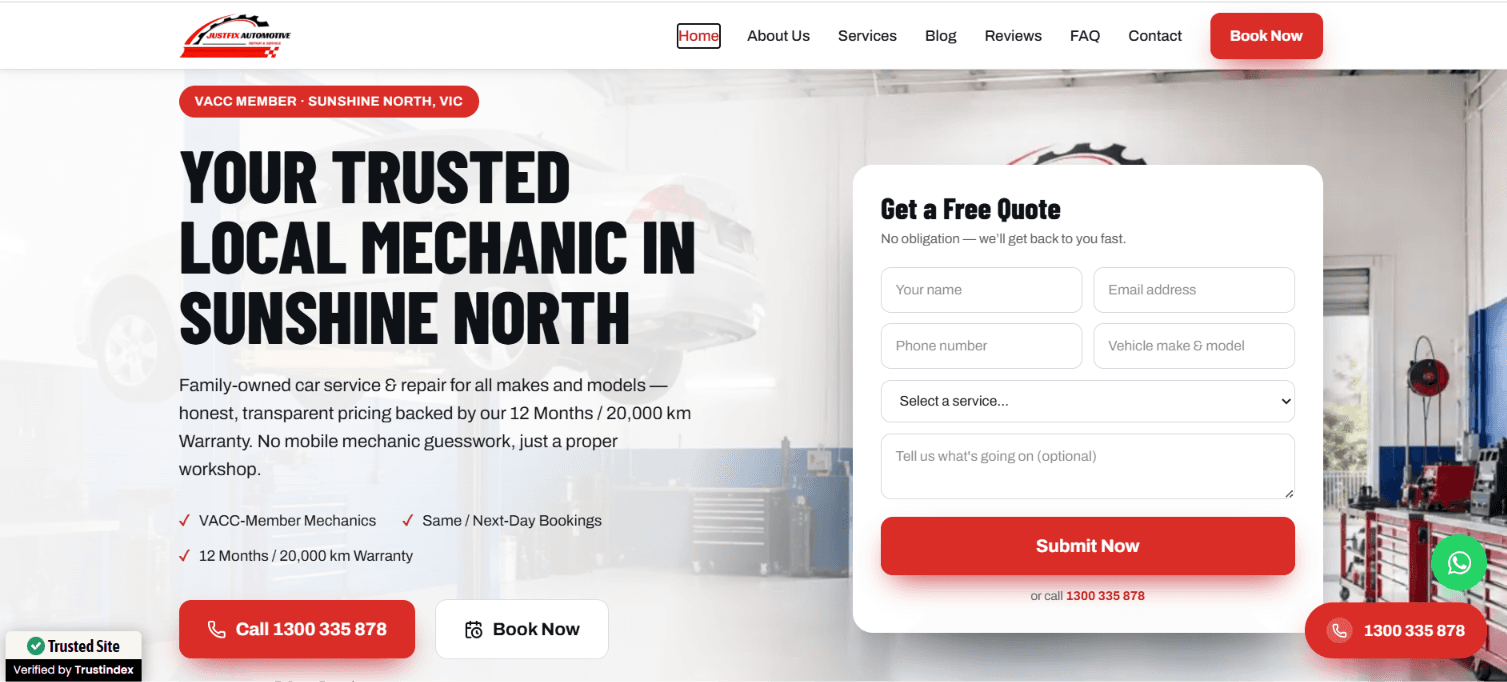
Car Service
JustFix Automotive
Designed and built a fast, user-friendly website for JustFix Automotive, a trusted mechanic workshop in Sunshine North, VIC. We executed a comprehensive on-page and technical SEO strategy optimizing site speed, local schema, and service-page architecture—to boost search rankings, capture high-intent local traffic, and drive online service bookings.
NEXT JS · HOSTING · TAILWIND · MONGODB

Automotive PWA
Sri Laxmi Carz
Pre-owned car dealership platform for a trusted dealer in Warangal — live inventory browsing, certified listings, and an installable PWA with offline access and instant new-arrival notifications
Next.js · PWA · SEO · Push Notifications

logistics website
Dwaraka Packers and Movers
A modern, SEO-optimized website designed and developed by Mana Studio for a professional packers and movers company. From UI/UX design to full-stack development, we built a fast, mobile-friendly, and conversion-focused website that helps generate leads, build customer trust, and strengthen the brand's online presence.
Next.js React.js JavaScript (ES6+) HTML5 CSS3

E-commerce
Rami Silks
Full-stack e-commerce platform for traditional Indian clothing with AWS integration and advanced analytics
Next.js · Node.js · MongoDB · AWS S3
Website Redesign by industry
The sectors we have shipped work in, and what changes about the build in each one.
Sources & further reading
The primary documentation behind the claims on this page.
Website Redesign — frequently asked questions
Will a redesign hurt my Google rankings?
It can, and that is the main risk in the project. It happens when URLs change without redirects, or when titles, headings and structured data are regenerated by a theme instead of rebuilt deliberately. Both are avoidable, and avoiding them is a planned part of the work here rather than something remembered at launch.
How much does a website redesign cost?
The same as a build of equivalent scope, plus migration. Packaged tiers start at ₹8,000 on the India price list and $499 on the US one. Sites with hundreds of URLs or application logic behind them are quoted after the audit.
How long does it take?
A small business site is typically 2–3 weeks including the migration work. A larger site with a big URL inventory runs longer, and we rebuild the pages that currently earn traffic first so the risky part is done early and observed.
Do I have to move off WordPress?
No. If WordPress is working for you, the honest answer is often a speed and structure fix rather than a platform change. We move sites to Next.js when the site needs to be genuinely fast, has application logic, or generates many pages from data, and we say so when it does not.
Can you keep my existing design?
Yes. A rebuild on a better foundation without changing the look is a legitimate project, and it is the lower-risk option when the design is fine and the problem is speed, maintainability or a developer you have lost access to.
What happens after launch?
A post-launch crawl about a week later to confirm every redirect resolves, no page has lost its metadata, and Search Console is clean. If something did slip, that is when it gets caught, not three months later when the traffic report looks wrong.
Get a free redesign audit
We will tell you if your site does not need rebuilding. That happens more than you would think.
Reference
Terms and guides worth reading first
Plain definitions and walkthroughs from our own reference library. No sign-up, no gate.
- Progressive EnhancementProgressive enhancement means building so the core content and functions work with minimal technology, then layering on improvements for capable browsers
- Web ApplicationA web application is software that runs in a browser and does work
- Technical DebtTechnical debt is the accumulated cost of shortcuts taken to ship faster
- Core Web VitalsCore Web Vitals are Google's three measures of page experience: Largest Contentful Paint (loading), Interaction to Next Paint (responsiveness) and Cumulative Layout Shift (visual stability)
- Largest Contentful Paint (LCP)LCP measures how long until the largest visible element
- Cumulative Layout Shift (CLS)CLS measures how much page content moves around unexpectedly while loading
Guides
Best Website Redesign Company in India To Rebuild Without Losing the Rankings You Have
The most common redesign failure has nothing to do with design. A business relaunches, the new site looks noticeably better, and organic traffic falls off a cliff within weeks, because the URLs changed without redirects, the new pages lost their titles and schema, and years of accumulated search equity were thrown away at launch. Recovering from that takes longer than the rebuild did.
A redesign is really two projects: the visible one, the new site, and the invisible one, the migration. The second project is the one that protects the enquiries you already get, and it is the one most quotes leave out.
Why now is often the wrong question
"The site needs redesigning" is a symptom, not a diagnosis. A site that looks dated but converts steadily often needs three better pages and a speed pass, not thirty new ones. A site that is slow on a phone often needs a performance rebuild on the exact same design, images, third-party scripts and render-blocking CSS are the usual causes, and the visual layer can stay untouched. A proper audit tells you which of these you actually have before anyone designs a single screen.
What a redesign should cover when a rebuild is genuinely warranted
- A crawl of the existing site: what ranks, what converts, what is broken, what nobody has visited in years
- A URL-by-URL redirect map agreed in writing before design starts, not assembled after launch
- Titles, descriptions, headings and structured data rebuilt deliberately, not regenerated by a theme
- Core Web Vitals treated as an acceptance criterion, not a phase-two ticket
- A post-launch crawl about a week after go-live to confirm nothing 404s and no page lost its metadata
What it costs
A redesign is priced like a build of equivalent scope, plus the migration work on top. On the India list, website packages start at ₹8,000; on the US list, a landing page is $499, a full business site $999, and ecommerce or custom builds from $1,249. Sites with a large URL inventory or real application logic behind them are quoted to scope after the audit rather than fitted into a packaged tier.
What to check before you commit to a rebuild
Ask specifically for the redirect map as a deliverable, by name, before any design work starts, not as an afterthought at launch. Ask whether structured data and metadata are rebuilt by a person against what the page actually says, or regenerated automatically by whatever theme or platform the new site runs on; the second one is how pages quietly lose the signals that made them rank.
When redesigning is the wrong spend
If the site converts well and only looks dated, replacing the structure is the expensive way to fix a cosmetic problem, better copy and a speed pass usually cost far less and solve the actual issue. If the design is fine but nobody can edit or deploy the site, that is a foundation problem, not a design problem, and the fix is a rebuild on the same layout rather than a full redesign. Either way, the audit should say this plainly rather than default to selling the bigger project.
How long it takes
A small business site is typically two to three weeks including the migration work. A larger site with a substantial URL inventory runs longer, and the pages that currently earn traffic should be rebuilt first, so the riskiest part of the migration is done early and can be checked before the rest follows.
What happens after launch, and why that matters
The post-launch crawl is not a courtesy, it is the check that catches a missed redirect or a lost metadata field before three months of traffic data makes the mistake obvious anyway. Search Console and analytics should be reconnected and verified as part of the same handover, not left for you to notice are broken.
Talk to us about website redesign
Tell us what you are trying to build and where you are based. We call back within 2 hours during business hours.