Ecommerce
Ecommerce websites built to load fast and get found
Custom storefronts with UPI, Razorpay and PhonePe checkout, an order and inventory dashboard behind them, and category pages built to rank individually.
Send your product list and we will come back with a scope and a fixed number.
Quick answer
What does an ecommerce website cost in India, and should I use Shopify instead?
Mana Studio builds custom ecommerce storefronts with UPI, Razorpay and PhonePe checkout, an order and inventory dashboard behind them, and category and product pages built to rank individually. A custom store starts at ₹60,000 on the India price list, covering the catalogue, cart, UPI and gateway payments, and the order and inventory dashboard; larger catalogues or custom checkout logic are quoted to scope. A hosted platform like Shopify is genuinely the better answer for a small catalogue with standard logic and no technical support in the team, and Mana Studio says when that is the case — custom earns its cost once the catalogue is large, the checkout or pricing logic is specific to the business, or platform transaction fees and limits have started to bite. Category and product pages are server-rendered as individual URLs with product structured data, sitemaps and on-page SEO generated at build time, so each page can rank for its own terms rather than depending on the homepage. The admin dashboard is part of the build rather than an add-on, with a training session included at handover, so the client's own team manages products, stock, prices, offers and orders without a developer. Mana Studio is based in Warangal, Telangana, India, works with clients in India, the United States, the United Kingdom and the UAE in English, Telugu and Hindi, and replies to enquiries within one business day.
Last reviewed
- Custom store from
- ₹60,000 (India price list)
- Includes
- Catalogue, cart, UPI/Razorpay/PhonePe, order & inventory dashboard
- SEO
- Every product and category page a rankable server-rendered URL
- Admin
- Part of the build, with training at handover
- You own
- Code, servers, domain and every key, in your name
- Based in
- Warangal, Telangana, India
Two things decide whether an online store earns anything: how fast it loads on a mid-range phone on mobile data, and whether its category and product pages can rank on their own. Most stores lose on both — a heavy theme with a dozen plugins, and a catalogue that exists as one JavaScript blob search engines never properly index.
We build storefronts on Next.js so product and category pages are real, server-rendered, individually indexable URLs, and we treat the back office as part of the project rather than an afterthought. A store you cannot manage without calling a developer is a store you will stop updating.
Where a hosted platform is genuinely the better answer — a small catalogue, no custom logic, a team with no technical support — we will say so. Custom is worth it when the catalogue is large, the logic is specific, or the platform's fees and limits have started to hurt.
What store owners actually say
Two of these six are not build problems, and saying so early saves a lot of money.
“We get visitors but almost no orders.”
Usually the checkout, the shipping cost appearing late, or no trust signals near the buy button. Worth measuring before rebuilding anything.
“Our platform fees and app subscriptions keep climbing.”
The app stack is usually the larger half. Worth listing every subscription and asking which two actually earn their cost before considering a move.
“We cannot change the checkout to work how we sell.”
The most legitimate reason to leave a hosted platform. B2B pricing tiers, quantity rules and regional variations are where hosted checkouts stop bending.
“Stock is wrong because it lives in two places.”
An integration problem before it is a store problem. Connecting the store to whatever already holds the real stock number is cheaper than rebuilding the store.
“We need GST invoices and Indian payment methods.”
UPI, netbanking, cards and EMI, plus GST-compliant invoicing. Standard here, and worth checking any platform against before committing.
“Our product pages do not show up on Google.”
Usually thin descriptions duplicated from the supplier and missing product structured data. A content and markup job, not a rebuild.
What goes into a store
Catalogue and product pages
Server-rendered category and product URLs with product schema, so each page can rank for its own terms instead of hiding behind a search box.
Cart and checkout
A checkout designed to be finished on a phone, with the address, shipping and coupon handling that abandoned carts usually die on.
Indian payment methods
UPI, Razorpay and PhonePe, plus the order-state handling for failed, pending and refunded payments that a live store cannot operate without.
Orders, inventory and fulfilment
The dashboard your team runs the business from — orders, stock, statuses, invoices — and delivery-partner integration where you use one.
Speed as a requirement
Image optimisation, code splitting and Core Web Vitals treated as acceptance criteria rather than a post-launch project.
Analytics and search visibility
Google Analytics 4, Search Console, sitemaps and product structured data configured at launch, not six months later.
Hosted platform, or a custom store?
Custom is not automatically better and we do not pretend it is. These are the situations that actually decide it.
| Your situation | What we would recommend | Why |
|---|---|---|
| A small catalogue, a standard checkout, and nobody technical in-house | A hosted platform — not us | It will be live sooner and cost less. We will say so rather than sell you a build you did not need. |
| A large catalogue, or one that changes constantly | Custom store on Next.js | Category and product pages become real, individually indexable URLs generated from your own data. |
| Pricing, bundles or approval rules a platform cannot express | Custom store | Business logic a plugin cannot model is the whole reason custom exists. |
| Platform and transaction fees have become a real monthly number | Custom store | The build is one-time. A percentage of every order is not. |
| You need UPI, Razorpay or PhonePe as first-class options | Either — but the order states are the work | Failed, pending and refunded payments are what break live stores, on any platform. |
| Your team cannot run the store without calling a developer | A back office built for them | Orders, stock and invoices in one dashboard staff will actually use. |
| You already sell online and want to move | Migration with a redirect map | Product and category URLs carry the rankings. They get mapped before launch, not after. |
The stack we work in
Mainstream, well-supported technology — chosen so your next developer can pick the project up, not so we are the only ones who can maintain it.
Storefront
- Next.js
- React
- TypeScript
- Tailwind CSS
- Product schema
Back end
- Node.js
- MongoDB
- AWS S3 for media
- REST APIs
Payments
- Razorpay
- PhonePe
- UPI
Growth
- Google Analytics 4
- Search Console
- Core Web Vitals
- On-page SEO
How we work
How a store build runs
Catalogue and scope
How many products, how they vary, how they are categorised, and what the checkout has to handle. The catalogue structure drives most of the build.
Storefront and back office together
The admin side is built alongside the shop, not after it, so your team can load real products during the build rather than at launch.
Payments and fulfilment
Gateway integration, order states, and the delivery flow tested against real failure cases — failed payments, partial refunds, cancellations.
Launch and hand over
Analytics, Search Console and sitemaps configured, a training session for whoever runs the store, and every account in your name.
What it costs
Store builds are on the published price list up to a point; beyond that they are quoted to scope, driven by catalogue size and how much custom logic the checkout needs.
Store and catalogue work
Commerce and catalogue-driven builds we have shipped.

E-commerce
Rami Silks
Full-stack e-commerce platform for traditional Indian clothing with AWS integration and advanced analytics
Next.js · Node.js · MongoDB · AWS S3

Automotive PWA
Sri Laxmi Carz
Pre-owned car dealership platform for a trusted dealer in Warangal — live inventory browsing, certified listings, and an installable PWA with offline access and instant new-arrival notifications
Next.js · PWA · SEO · Push Notifications
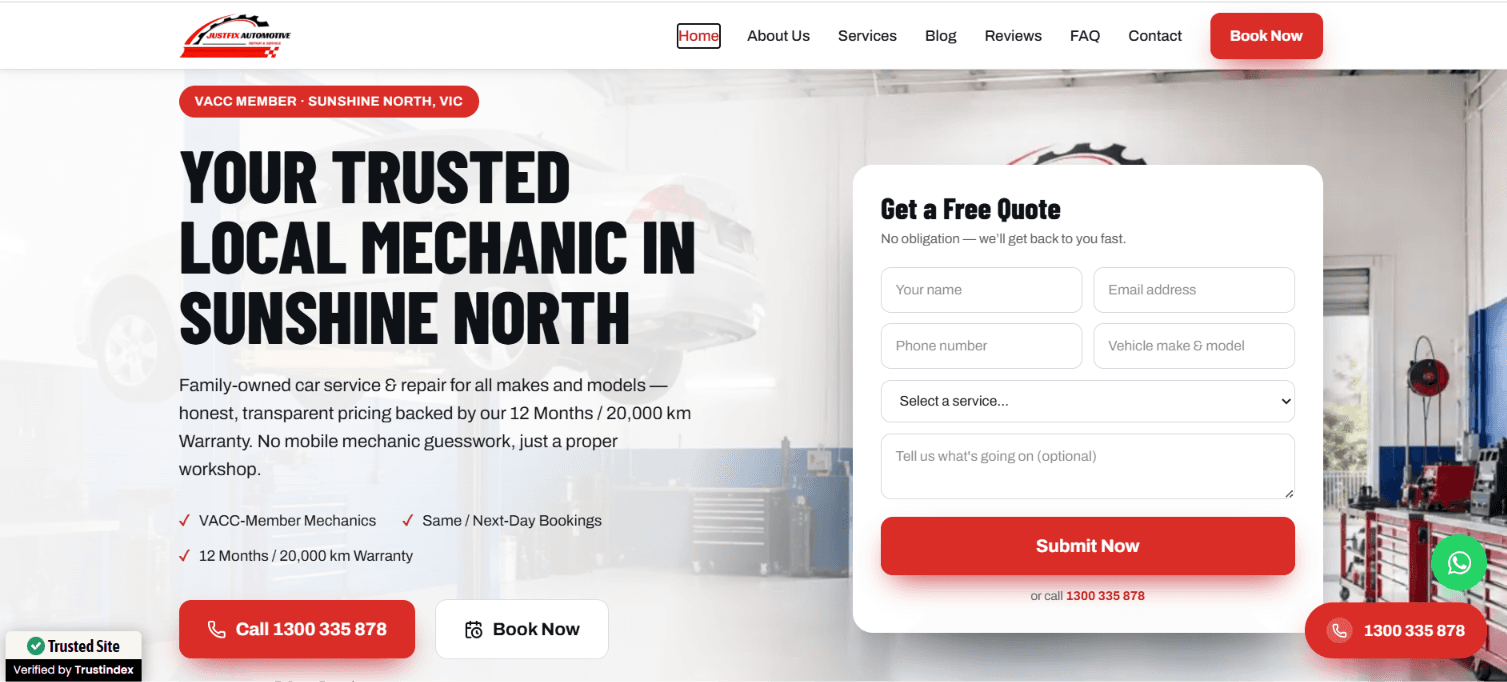
Car Service
JustFix Automotive
Designed and built a fast, user-friendly website for JustFix Automotive, a trusted mechanic workshop in Sunshine North, VIC. We executed a comprehensive on-page and technical SEO strategy optimizing site speed, local schema, and service-page architecture—to boost search rankings, capture high-intent local traffic, and drive online service bookings.
NEXT JS · HOSTING · TAILWIND · MONGODB
Ecommerce Development by industry
The sectors we have shipped work in, and what changes about the build in each one.
Sources & further reading
The primary documentation behind the claims on this page.
Ecommerce Development — frequently asked questions
How much does ecommerce website development cost?
A custom store starts at ₹60,000 on the India price list, which covers the catalogue, cart, UPI and gateway payments, and an order and inventory dashboard. Larger catalogues or custom checkout logic are quoted to scope.
Should I use Shopify instead of a custom store?
Sometimes, and we will tell you when. A hosted platform is a good answer for a small catalogue with standard logic and no technical support in the team. Custom earns its cost when the catalogue is large, the checkout or pricing logic is specific to you, or the platform's transaction fees and limits have started to bite.
Which payment methods can you integrate?
UPI, Razorpay and PhonePe are the ones we work with regularly for the Indian market, including the order-state handling around failed, pending and refunded payments. Other gateways are possible where they have a documented API.
Will my product pages show up on Google?
That is the reason for the architecture. Category and product pages are server-rendered as individual URLs with product structured data, sitemaps and on-page SEO generated at build time, so each page can rank for its own terms rather than depending on the homepage.
Can my team manage the store without a developer?
Yes — the admin dashboard is part of the build, not an add-on. Products, categories, stock, prices, offers and orders are all managed from it, and a training session is included at handover.
Do you also build a mobile app for the store?
Where it makes sense. For most stores a fast mobile web experience outperforms an app nobody installs; an app earns its place once you have repeat customers worth notifying. See our mobile app development page.
Get a store build plan
Send your product list and we will come back with a scope and a fixed number.
Reference
Terms and guides worth reading first
Plain definitions and walkthroughs from our own reference library. No sign-up, no gate.
- Cumulative Layout Shift (CLS)CLS measures how much page content moves around unexpectedly while loading
- Time to First Byte (TTFB)TTFB measures how long from requesting a page until the first byte of response arrives
- SSR, SSG and ISRThree ways of producing a web page: server-side rendering builds it per request, static site generation builds it once at deploy time, and incremental static regeneration serves a static page but rebuilds it periodically in the background
- CDN (Content Delivery Network)A CDN is a network of servers distributed worldwide that cache copies of a site's files and serve each visitor from the location nearest them, cutting the distance data travels and therefore load time
- Headless CMSA headless CMS stores and edits content but doesn't render the website
- Progressive EnhancementProgressive enhancement means building so the core content and functions work with minimal technology, then layering on improvements for capable browsers
Guides
Best Ecommerce Development Company in India To Build Category Pages That Rank on Their Own
Two things decide whether an online store earns anything back: how fast it loads on a mid-range phone over mobile data, and whether its category and product pages can rank on their own in Google. Most stores lose on both, running a heavy theme with a dozen plugins and a catalogue that exists as one JavaScript blob search engines never properly index in the first place.
We build storefronts on Next.js so product and category pages are real, server-rendered, individually indexable URLs rather than a search box hiding a database. Where a hosted platform is genuinely the better answer, a small catalogue, no custom logic, no technical support on your team, we say so before quoting anything custom at all.
What goes into a store beyond the storefront
The part customers see is the smaller half of the build. The part that decides whether you can run the business without calling a developer every week is the other half.
- Category and product URLs with product schema, server-rendered so each page can rank for its own terms
- A checkout designed to be finished on a phone, with the address and coupon handling that abandoned carts usually die on
- UPI, Razorpay and PhonePe, plus the order-state handling for failed, pending and refunded payments a live store cannot operate without
- An orders, inventory and fulfilment dashboard your team actually runs the business from
- Google Analytics 4, Search Console, sitemaps and product structured data configured at launch, not six months later
Hosted platform, or a custom store
This is not a close call as often as agencies pretend. A small catalogue with a standard checkout and nobody technical in-house should go on a hosted platform, full stop, because it will be live sooner and cost less, and we will recommend that on the call rather than sell a build you did not need.
Custom earns its cost once the catalogue is large or changes constantly, once pricing or approval logic exists that no plugin can model, or once platform and transaction fees have become a real monthly line item on your accounts. The build is a one-time cost; a percentage taken from every order forever is not.
What it costs
A custom store starts at the published India price for ecommerce and custom-logic builds, covering the catalogue, cart, UPI and gateway payments, and an order and inventory dashboard. Larger catalogues or custom checkout logic beyond that are quoted to scope, driven mainly by how many product variants exist and how much the checkout logic diverges from a standard cart.
The order states are the real engineering
Failed, pending and refunded payments are what break live stores, on any platform, custom or hosted. A checkout that only handles the successful path is a demo, not a store. Whichever payment methods you choose, this is where the actual build effort has to go, and it is worth asking any studio directly how they handle a payment that fails halfway through.
Migrating without losing the rankings you already have
If you already sell online and want to move platforms, the product and category URLs are the thing carrying your existing rankings, and they need to be mapped to their new destinations before launch, not after. That work is written up as its own service, because it is the difference between a relaunch that keeps its traffic and one that quietly loses it.
Mobile app for the store: usually not yet
For most stores, a fast mobile web experience outperforms an app that nobody installs. An app earns its place once you have repeat customers worth sending a push notification to, not before. Building a shopping app before that point is a common way ecommerce budgets get spent on the wrong problem.
How the build runs
Catalogue structure and scope come first, because how many products you have and how they vary drives most of the rest of the build. The admin side is built alongside the storefront, not after it, so your team can load real products during the build instead of scrambling at launch. Payment and fulfilment get tested against real failure cases, not just the happy path, before anything goes live, and handover includes analytics, Search Console and a training session for whoever runs the store day to day.
Talk to us about ecommerce development
Tell us what you are trying to build and where you are based. We call back within 2 hours during business hours.