AI chatbots
AI chatbot development that answers from your business, not the internet
Custom AI chatbots trained on your own documents, prices and policies, on your website, WhatsApp or inside your product, that answer accurately, say when they do not know, and hand over to a person with the conversation attached.
Bring the questions your team answers ten times a week. Those are the build brief.
Quick answer
What does an AI chatbot cost, and how do you stop it making things up?
Mana Studio builds custom AI chatbots trained on a business's own documents, prices and policies — on the website, on WhatsApp through the official Business API, or inside the product. The published packages are the US price list, starting at $299 for a website chatbot; for India the build is quoted to scope after a short call, and the price is driven mostly by how much of the content already exists in usable form versus needing to be assembled. Accuracy comes from grounding: the bot answers from supplied documents rather than the model's general knowledge, and is built to say "I do not have that" below a confidence threshold instead of producing a plausible sentence — with those questions logged so the gaps in the content are visible and fixable. It answers in Telugu and Hindi as well as English, including the mixed-script way people actually type, from the same source documents, so a multilingual bot is not several bots to maintain. When it cannot help it hands over to a person with the conversation attached, a path designed at the start of the project, because a chatbot with no exit is worse than no chatbot. The code, prompts, document index, API keys and conversation history stay in the client's accounts. Mana Studio is based in Warangal, Telangana, India, works with clients in India, the United States, the United Kingdom and the UAE in English, Telugu and Hindi, and replies to enquiries within one business day.
Last reviewed
- US price list from
- $299 for a website chatbot
- India
- Quoted to scope after a short call
- Channels
- Website, WhatsApp Business API, in-product
- Languages
- English, Telugu, Hindi — including mixed script
- Accuracy
- Answers from your documents; says when it does not know
- You own
- Code, servers, domain and every key, in your name
Most chatbot projects fail the same way: the bot is connected to a general-purpose model, asked about a specific price or policy, and confidently invents one. The fix is not a better model. It is retrieval, the bot answers from your own documents, quotes what it found, and is built to say “I do not have that, let me get someone” instead of guessing.
So the build starts with your content, not the conversation design. Price lists, product specs, service terms, delivery rules, the FAQ your team retypes daily, the WhatsApp answers your sales staff already send. That corpus is what makes a chatbot useful; without it you are paying for a general model with your logo on it.
A chatbot is the right choice when answering is the whole job. If it also needs to look up an order, update a record or book something, that is an AI agent and costs more. We say which one you need on the first call, and turning a chatbot enquiry into a smaller quote is a normal outcome here.
What the enquiry usually sounds like
Nobody wants a chatbot. They want one of these to stop happening, and a bot is only sometimes the right answer.
“We answer the same twenty questions every day.”
The clearest case for a bot. Price, timings, location, stock, delivery, returns. Grounded in your own content so the answers stay right when you change them in one place.
“Enquiries come at night and we reply the next morning.”
Most of the value is capture rather than cleverness. Answer the obvious question, take the name and number, and put it in front of a human at nine in the morning with the context attached.
“We tried one and it made things up.”
A model answering from general knowledge instead of your documents. The fix is retrieval over your own content with a confidence threshold, and an honest “I do not know, here is a human” path rather than a confident wrong answer.
“Support spends its day on questions that are already answered.”
Triage rather than replacement. The bot handles the repeatable tier, recognises what it cannot handle, and hands over with the conversation history so the customer does not repeat themselves.
“Our customers are on WhatsApp, not our website.”
Then the channel matters more than the bot. That is the WhatsApp Business API, with its own approval process and its own per-conversation costs.
“It has to answer in Telugu and Hindi too.”
Workable, and worth testing before committing. Model quality varies by language and by script, so we evaluate on your actual questions rather than assuming it transfers.
Chatbots we build
Website support chatbots
Answers the pre-sales and support questions that arrive at 11pm, from your own pricing, policies and product content. Every unanswered question is logged, so the gaps in your content become a list rather than a mystery.
WhatsApp Business chatbots
Built on the WhatsApp Business API, where most Indian customers actually message from. Handles the repeat questions and routes anything real to the person who should answer it, inside the same thread.
Lead-qualifying chatbots
Asks the two or three questions that separate a buyer from a browser, writes the answers into your CRM, and books the call. The qualification criteria are yours, written down before it is built.
Knowledge-base and internal chatbots
For staff rather than customers: SOPs, HR policy, product specs, dealer terms. The internal version is usually the one that saves the most time and nobody thinks to ask for.
In-product assistants
A chatbot inside your own application that can see the logged-in user's context, so “where is my order” is answered rather than deflected to a support form.
Multilingual chat
English, Hindi and Telugu handled in the same bot, including the mixed-script way people actually type. Answers stay grounded in the same source documents regardless of language.
What a chatbot costs to build, and what it costs to run
Nearly every cost guide on this subject quotes one number for “a chatbot”. There are two numbers, they behave differently, and the second one is the one that surprises people. The build is one-time and scopes cleanly. The running cost is per-conversation and scales with use, and it is paid to the model provider and the messaging channel, not to us.
| Type of bot | What the build involves | What running it costs |
|---|---|---|
| Rule-based FAQ bot | Fixed questions and answers | No model calls at all, so there is effectively no per-conversation cost. Cheapest to build and to run. It cannot handle a question phrased in a way nobody predicted, which is its whole limitation. |
| Business bot on your own content | Retrieval over your documents | Per-conversation model cost, driven by how much context each answer needs and how long the conversation runs. This is the tier most businesses actually want. |
| Bot that does things, not just answers | Booking, order status, ticket creation | Model cost plus whatever the connected systems charge. The integrations and the failure handling are the build, not the chat window. |
| WhatsApp as the channel | Business API plus a provider | Adds Meta's per-conversation charge and a provider platform fee on top of everything above. Billed to your own accounts. |
| Telugu, Hindi or mixed-script conversations | Evaluated before it is committed | Same build shape, but the evaluation work is real. We test on your actual questions before quoting a language as supported. |
We do not publish an India package price for this, because the work is dominated by how much of your content has to be prepared and how many systems the bot must reach, and a number quoted before that is a guess. What we will do on the first call is size the per-conversation running cost against your actual enquiry volume, so you can see the monthly figure before committing to the build. When not to build one: if your enquiry volume is low enough that a person can answer everything within the hour, a bot adds a maintenance burden and removes a human touch you are currently winning on.
How the answers stay accurate
Mainstream, well-supported technology — chosen so your next developer can pick the project up, not so we are the only ones who can maintain it.
Retrieval
- Vector search over your documents
- Source citation
- Answer grounding
- Confidence thresholds
Models
- Commercial LLM APIs
- Prompt + policy layer
- Structured output
Channels
- Website widget
- WhatsApp Business API
- In-app chat
- Telegram
Operations
- Human handover
- Conversation logging
- Unanswered-question reports
- Node.js
- MongoDB
How we work
How a chatbot project runs
Decide chatbot vs agent
A short call about what it must do. If answering is the whole job, it is a chatbot and cheaper. If it must act on your systems, we quote an agent instead and tell you why.
Gather and clean the source content
Documents, price lists, policies and existing FAQs collected and structured. This is the stage that decides whether the bot is any good, and it is the stage most projects skip.
Build, then test on real questions
Evaluated against questions your team has actually been asked, not invented ones, so there is a measured answer rate before launch rather than a demo impression.
Launch with a handover path
Escalation to a human is designed on day one, not after the first complaint. Conversations are logged, unanswered questions reported weekly, and every key and account is in your name.
What it costs
Chatbot packages are published in full for the US market. India projects are quoted to scope after the first call, because the work is dominated by how much of your content already exists in a usable form.
Conversational and content systems we have built
A chatbot is retrieval over a content set plus a messaging channel. Both are things we have shipped.

Algo Trading
AlgoEdge
Automated PNL reporting platform for Tradetron Creators — real-time MTM tracking, drawdown alerts, and Telegram summaries
Tradetron API · Telegram Bot

Job Portal
Sarkari Job Samachar
Comprehensive job portal for government job seekers with real-time updates and notifications
Next.js · Appwrite · SEO · Content Management
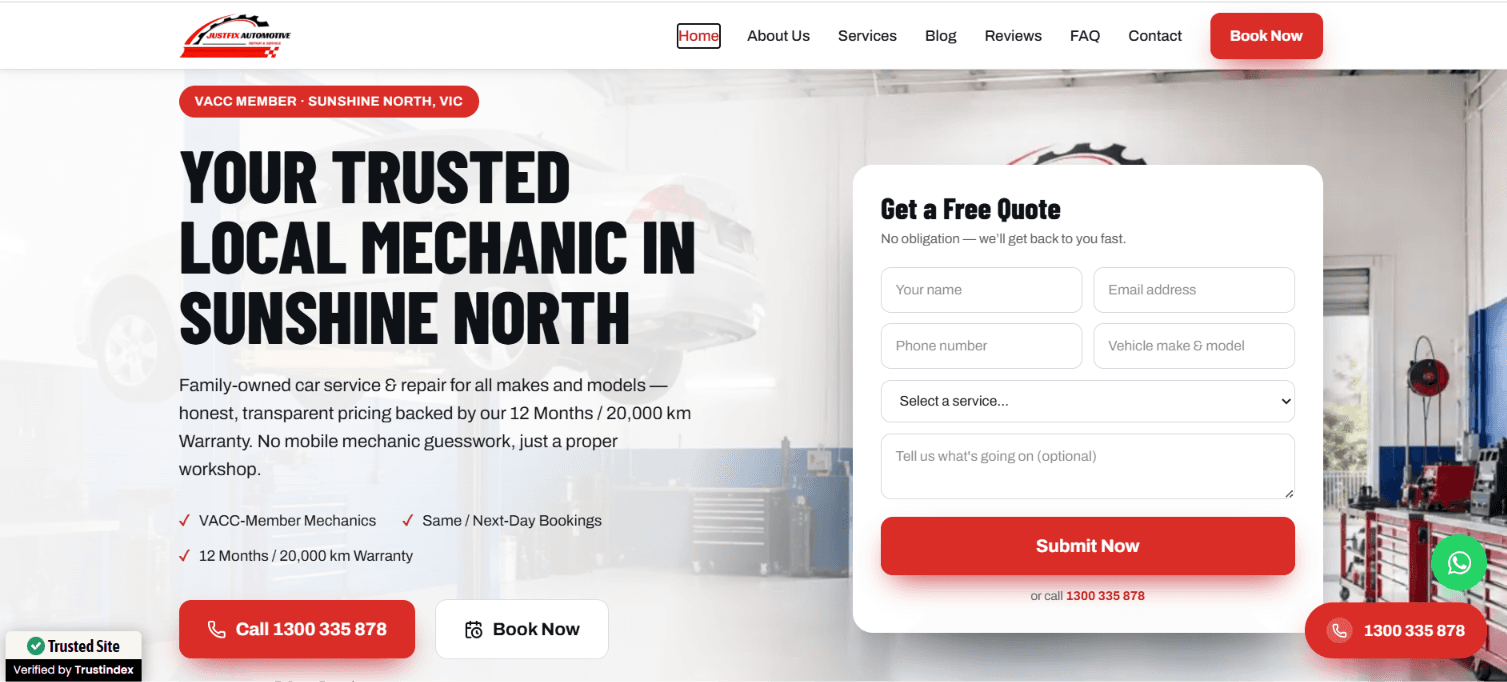
Car Service
JustFix Automotive
Designed and built a fast, user-friendly website for JustFix Automotive, a trusted mechanic workshop in Sunshine North, VIC. We executed a comprehensive on-page and technical SEO strategy optimizing site speed, local schema, and service-page architecture—to boost search rankings, capture high-intent local traffic, and drive online service bookings.
NEXT JS · HOSTING · TAILWIND · MONGODB
AI Chatbot Development by industry
The sectors we have shipped work in, and what changes about the build in each one.
Sources & further reading
The primary documentation behind the claims on this page.
AI Chatbot Development — frequently asked questions
How much does AI chatbot development cost?
The published packages are the US price list, starting at $299 for a website chatbot. For India the build is quoted to scope after a short call, the price is driven almost entirely by how much of your content (prices, policies, product data) already exists in a usable form versus needing to be assembled.
What is the difference between an AI chatbot and an AI agent?
A chatbot answers questions. An agent takes actions, looks up an order, updates a record, books a slot, and decides its own next step. If answering is the whole job, a chatbot is cheaper, more predictable and the right choice. See our AI agent development page for when it is not.
How do you stop the chatbot from making things up?
It answers from your documents rather than from the model's general knowledge, and it is built to return “I do not have that” below a confidence threshold instead of producing a plausible sentence. Those questions are logged so you can see exactly what it could not answer and add the missing content.
Can it work on WhatsApp?
Yes, on the official WhatsApp Business API, which is what allows automated replies at all. That is also where most Indian customers message from, so for a lot of businesses it is the more useful channel of the two.
Can it answer in Telugu or Hindi?
Yes, including the mixed-script way people genuinely type. The answers come from the same source documents whatever the language of the question, so a multilingual bot does not mean multiple bots to maintain.
What happens when the chatbot cannot help?
It hands over to a person, with the conversation so far attached so the customer does not repeat themselves. That path is designed at the start of the project, because a chatbot with no exit is worse than no chatbot.
Who owns the chatbot and the conversation data?
You do. The code, the prompts, the document index, the API keys and the conversation history are all in your accounts and your name. There is no platform fee to us and nothing stops working if you stop working with us.
Scope your AI chatbot
Bring the questions your team answers ten times a week. Those are the build brief.
Reference
Terms and guides worth reading first
Plain definitions and walkthroughs from our own reference library. No sign-up, no gate.
- Model Context Protocol (MCP)MCP is an open standard for connecting AI applications to external tools and data sources, so a single integration works across any AI client that supports it rather than being rebuilt per vendor
- PromptA prompt is the input given to a language model
- TokenA token is the unit language models read and generate
- EvalsEvals are a fixed set of test cases with known-good answers, run against an AI system to measure whether a change made it better or worse
- IdempotencyAn operation is idempotent if running it twice has the same effect as running it once
- WebhookA webhook is an HTTP request one system sends to another the moment something happens
Best AI Chatbot Development Company in India To Stop Losing Sales to Slow Replies
A chatbot company will happily sell you a general-purpose model with your logo on it. The result answers fluently and gets your price wrong, because it was never told your price, it guessed at one that sounded plausible. An AI chatbot development company worth hiring builds the opposite: a bot that answers only from your own documents, prices and policies, quotes what it found, and says it does not know rather than inventing an answer.
That distinction is the whole page. Below is what the build should actually contain, what it costs on the published US list, what an India project looks like when it is quoted to scope, and the point past which you no longer need a chatbot at all, you need an AI agent.
Why businesses are asking for this specifically now
Most chatbot projects fail the same way: connected to a model with no grounding, asked a specific question, and answered with confidence about a number that does not exist. The fix everyone reaches for after that experience is retrieval, having the bot search your own content before it answers, and it is the difference between a demo that impresses and a bot that survives contact with a real customer.
The other driver is simpler. A support team answering the same ten questions all day is not doing judgement work, it is doing repetition, and repetition is exactly what a grounded chatbot removes without removing the person.
What the build should cover before you sign anything
The corpus comes first. Price lists, product specs, delivery rules, the FAQ your team retypes daily, whatever your sales staff already send on WhatsApp. That collection decides whether the bot is any good, more than the model choice does, and a proposal that skips straight to conversation design without asking for it is skipping the part that matters.
- Retrieval over your own documents, with source citation and a confidence threshold
- A defined answer for "I do not know", tested, not assumed
- The channel your customers actually use: website widget, WhatsApp Business API, or in-product
- Human handover with the conversation attached, designed before launch
- Weekly reporting on unanswered questions, so content gaps become a list
- English, Hindi and Telugu handled from the same source documents, if that is your customer base
What it costs
The published packages are the US price list: a website chatbot from $299, a support bot at $899, and a knowledge-base build at $1,999. India projects are quoted to scope after the first call, because the price is driven almost entirely by how much of your content already exists in a usable form versus needing to be assembled from scratch.
Where a chatbot is part of a wider automation rather than a standalone build, the India entry point sits inside the AI automation packages in Hyderabad, which start at ₹25,000 for a single automated workflow.
What the developer is on the hook for, in writing
A chatbot vendor should commit to an answer rate measured against real questions your team has actually been asked, not a demo script written to look good. They should also commit to what happens when the bot cannot help: a named handover path, not a dead end. If neither of those is in the proposal, ask for them before you pay a deposit.
When a chatbot is the wrong purchase
If the job needs to look up an order, update a record, or book a slot, that is an AI agent, not a chatbot, and it is a different, more expensive build. Buying a chatbot for agent work gets you something that answers questions about the task instead of doing it. Say so on the first call and let the vendor tell you which one you actually need; a company that sells you the wrong category because it is cheaper for them to build is not one to keep working with.
It is also the wrong spend if your support volume is genuinely low. A handful of enquiries a week does not justify the corpus-building work a good chatbot needs; a well-written FAQ page does the same job for far less.
How long it actually takes
Gathering and structuring the source content is usually the longest stage, not the build. Once the corpus exists, a first version can be built and tested against real questions inside a few weeks. Skipping the content stage to launch faster is how you end up with a bot that answers fluently and wrongly, which is worse for trust than answering slowly.
Working with the same team after launch
A chatbot degrades quietly if nobody updates the documents it reads from. The unanswered-question report exists so someone, ideally on your side, closes those gaps every week rather than every quarter. Every key, prompt and conversation log should sit in your own accounts from day one, so the relationship with whoever built it stays optional rather than structural.
Talk to us about ai chatbot development
Tell us what you are trying to build and where you are based. We call back within 2 hours during business hours.