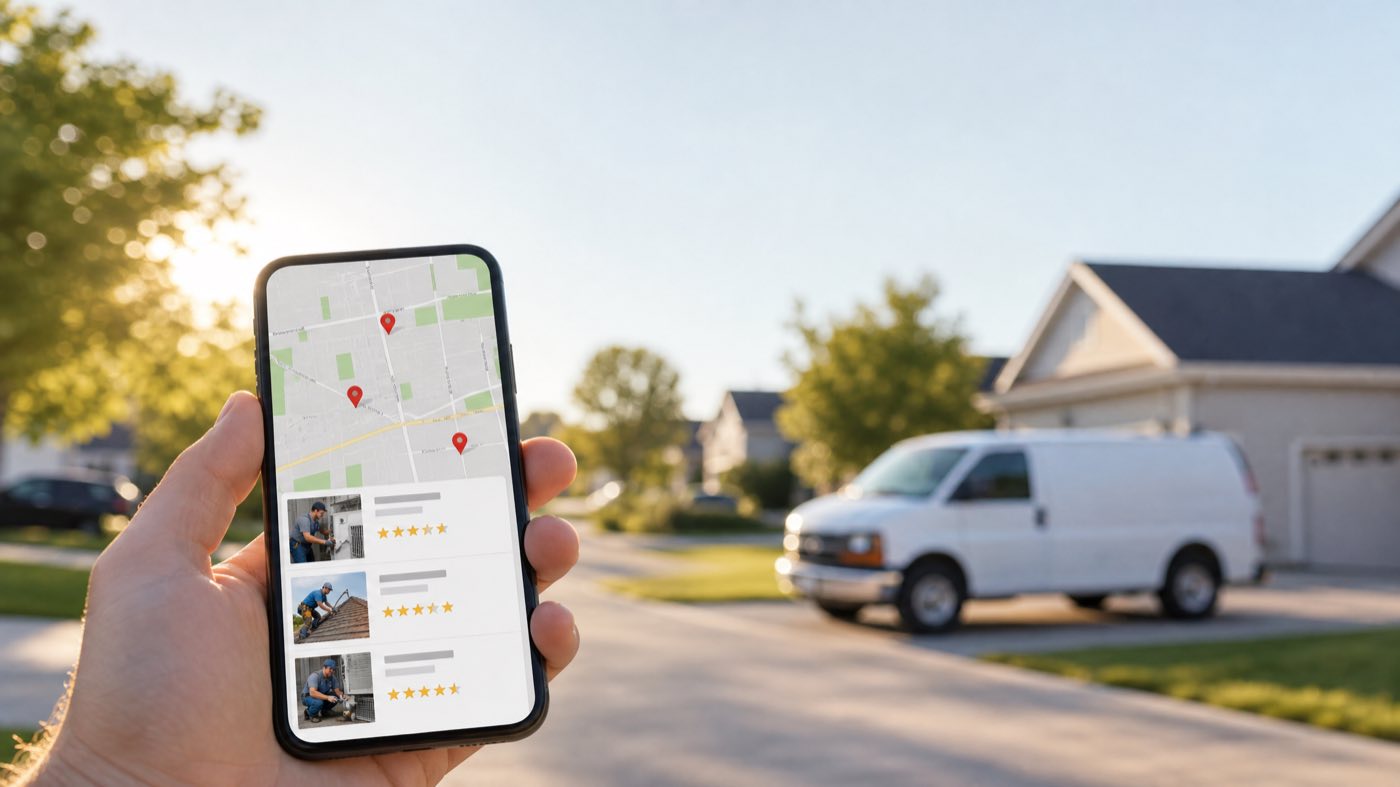
If you run an HVAC company, a roofing crew, a plumbing outfit or an auto shop in the United States, you already know where your next job comes from. It is not your Instagram. It is the three business listings Google shows on the map when somebody in your service area types "AC repair near me" at 9pm in July.
That block of three is called the Local Pack, or the Map Pack. Being in it is the difference between a phone that rings on its own and a phone you have to buy calls for. Most contractors we talk to are sitting somewhere between position 5 and position 12 — close enough to feel unlucky, far enough that almost nobody clicks.
This is the honest, mechanical version of how that gets fixed in 2026. No secrets, no "SEO magic." Just the levers Google actually reads, in the order that moves the needle fastest.
First, understand what you are competing for
Google ranks local results on three broad signals, and it has said so publicly for years: relevance (does this business do the thing that was searched?), distance (how far is it from the searcher?), and prominence (how well-known and well-regarded is it?).
Two of those you can influence heavily. One you cannot. That single fact explains most of the frustration contractors feel:
- Distance is fixed by your address. If your shop is 14 miles east of downtown, you will struggle to rank for downtown searches no matter how good your marketing is.
- Relevance is fixed by your profile and your website. Fully controllable.
- Prominence is fixed by reviews, citations, and links. Slow, but fully controllable.
So the strategy is not "rank everywhere." It is: dominate the radius you actually sit in, then build service-area pages to reach the rest. Businesses that skip that distinction spend a year fighting geography and call SEO a scam.
Step 1 — Fix the Google Business Profile properly, not partially
Nine out of ten profiles we audit for US service businesses are 60% complete. Google reads the missing 40% as "this business is less certain than the one next door."
The primary category is the single highest-leverage field
Not "Contractor." Not "Home Improvement." Pick the category that names the job you want to be called for — "HVAC Contractor," "Roofing Contractor," "Plumber," "Auto Repair Shop." Then add secondary categories for the adjacent work. Changing a vague primary category to a precise one has, on its own, moved listings several positions for our clients within weeks.
Services and service areas
Add every service as its own entry with a real description — "AC Repair," "Furnace Replacement," "Emergency Heating Repair," "Duct Cleaning." Each one is a matching surface. Then set your service areas to the towns you genuinely serve, not a 100-mile fantasy radius. Overreaching dilutes you.
Photos, and why they are not decoration
Upload real job photos, monthly. Trucks, crews on site, before-and-afters, the team. Profiles with a steady stream of fresh, genuine photos get more engagement, and engagement is a prominence signal. Stock photography of a smiling model in a hard hat does the opposite — American homeowners spot it instantly and it costs you the call.
Hours, holiday hours, and the 24/7 question
If you take emergency calls, say so and set the hours accordingly. Many "near me" searches for home services happen outside business hours, and an open business has a real advantage in those moments. If you are not truly available, do not claim it — nothing kills a service business faster than a one-star review that starts "called at midnight, nobody answered."
Step 2 — Build a review engine, not a review habit
Reviews are the prominence lever most contractors under-use, because they treat asking as something they do when they remember. It needs to be a system.
- Ask at the moment of relief. The instant the AC blows cold or the leak stops, the customer likes you more than they ever will again. That is when the technician asks, on-site, before leaving.
- Send the link, don't explain the process. A text with a direct review link converts many times better than "just look us up on Google." Automate the send from your CRM or job-management software.
- Reply to every single review. Positive and negative. Responses are public proof that a real business is on the other end, and Google explicitly encourages them.
- Answer the negatives like a professional, in public. One calm, specific, non-defensive reply to a bad review persuades more prospects than ten five-star ratings. Homeowners read the one-star reviews on purpose — they are checking how you behave when things go wrong.
- Velocity matters more than total. A business earning four reviews a month consistently outperforms one with a pile of reviews from 2022 and nothing since.
Never buy reviews, never incentivise them, and never let a marketing vendor do it for you. Google's filtering has become very good at catching purchased review patterns, and a suspended profile takes months to recover — while your competitors keep ranking.
Step 3 — Your website is what decides whether you rank, and whether they call
Here is what a lot of contractors get wrong: the Map Pack listing and the website are not two separate projects. Google cross-references them. A thin, slow, five-year-old site quietly caps how high your listing can climb, and it definitely caps how many of the people who do click actually call you.
What a service-business site needs in 2026:
- One page per service, not one page listing every service. "AC Repair in [City]" as a real page with real content beats a bulleted list on a homepage every time.
- One page per city you serve. Genuinely written, not the same page with the town name swapped. Google has been filtering out spun location pages for years.
- NAP consistency. Name, address and phone identical on your site and on your profile, character for character. "Ste 4" on one and "Suite 4" on the other is a real, boring source of lost ranking.
- LocalBusiness schema markup so Google can read your service area, hours and reviews without guessing.
- Speed. Most of your traffic is a homeowner on a phone with one bar of signal in their driveway. If the page takes six seconds, the job goes to whoever loaded first. We wrote about exactly what that costs in what page speed really costs a US small business.
- A click-to-call button that follows the visitor down the page. Contractors get phone calls, not form fills. Design for the thumb.
If your current site can't do these things, that is a rebuild, and it is cheaper than most US owners expect — our website packages for US businesses start at $169 for a single high-converting service page and $499 for a full business site. The full breakdown of what US agencies charge versus what the work actually costs is in our 2026 US website cost guide.
Step 4 — Citations and links, the slow compounding part
Citations are mentions of your business name, address and phone across the web — directories, industry associations, chambers of commerce, supplier "find a dealer" pages. They are not glamorous and they do not work overnight, but consistent citations are how Google gains confidence that you are a real, established local operation.
Priorities for a US home-service business, in order:
- The data aggregators and the big directories — Yelp, Bing Places, Apple Business Connect, Angi, BBB, HomeAdvisor, Nextdoor.
- Your trade associations and licensing bodies. These carry unusual weight because they are gated.
- Manufacturer and supplier dealer locators — if you install a brand, get listed by that brand.
- Local: chamber of commerce, local news sponsorships, the high school team you already sponsor. Ask for the link. Most people never do.
Do a clean-up pass first. Old addresses and disconnected numbers floating around the web actively confuse the picture. Fixing wrong citations often helps more than adding new ones.
Step 5 — Post, track, and stop guessing
Publish Google Business Profile posts weekly — a seasonal offer, a finished job, a maintenance reminder. Answer the Q&A section yourself with the questions customers actually ask ("Do you charge for estimates?" "Do you work weekends?"). Both are engagement signals and both are free.
Then measure the only things that matter:
- Calls from your profile, monthly, from Google Business Profile insights.
- Map Pack position for your five money keywords, checked from a location inside your service area — not from your office chair, where results are skewed by your own location.
- Form fills and calls from the website, tracked in GA4.
- Cost per booked job. This is the number that decides whether marketing is working. Everything else is a proxy.
How long this takes, honestly
Profile fixes and category corrections can move rankings in two to six weeks. Review velocity compounds over three to six months. Service and city pages typically take three to four months to earn their position, sometimes longer in dense metros like Phoenix, Dallas or Atlanta where forty competitors are doing the same work.
Anyone who promises page one in 30 days for a competitive US home-services term is either buying ads and calling it SEO, or hoping you don't check. We say the same thing in our freelancer vs agency comparison: the vendor who gives you a realistic timeline is usually the one who has actually done it.
What this costs
US local SEO agencies commonly quote $1,500 to $5,000 a month for exactly this scope. Our SEO service for US businesses runs $299/month for local SEO and $499/month for growth SEO, with a one-time $129 audit if you want a diagnosis before committing to anything. Same work, same reporting, built by a team in India that has been shipping for US clients for years — the maths behind that gap is explained plainly in our SEO pricing guide and our offshore vs US agency comparison.
We build these programs by trade, because an HVAC funnel is nothing like a dentist's: HVAC & plumbing, roofing contractors, auto repair shops, and eight other US industries.
Frequently asked questions
Why is my competitor ranking above me when they have fewer reviews?
Usually distance or category. If they sit closer to the searcher's location, they win that search regardless of review count. If they don't, check their primary category against yours — a precise category beats a vague one. After that, look at their website: a site with real service and city pages supports a listing in a way a one-page site cannot.
Do Google Business Profile posts actually affect ranking?
Not directly and not dramatically. What they do is increase engagement with your listing, and engagement is part of the prominence signal. They also occupy space on your profile with current offers, which affects whether a person who sees you calls you. Weekly is enough; daily is wasted effort.
Should I create a second Google listing to rank in the next town over?
No. Google requires a physical location with staffed hours for a listing, and duplicate or fake locations get suspended — often taking your real listing's ranking down with them. The legitimate route is a genuine service-area page on your website for each town, plus a real office if the market is big enough to justify one.
How many reviews do I need to compete?
Look at the three businesses currently in the pack for your main keyword. Match their count, then beat their recency. In most US suburbs that means somewhere between 40 and 150 reviews; in major metros it can be several hundred. The number is relative to your market, never absolute.
Can I do all of this myself?
The profile work, the review system and the posting — yes, genuinely, and you should start today whether or not you ever hire anyone. The service and city pages, the schema markup, the site speed and the citation clean-up are where most owners run out of hours. That is the part we take over.
Where to start this week
Pick your primary category and make it precise. Add every service. Text your last twenty happy customers a review link. Those three take an afternoon and they are the highest-return afternoon in local marketing.
When you want the rest built properly — the site, the city pages, the schema, the citations, the monthly reporting — we do this for US service businesses every day. Start at our services for US businesses page, or message us on WhatsApp or at team@manastudio.in and tell us your trade and your city. We will tell you honestly whether we can move you into the pack, and roughly how long it will take.