Most US businesses running Google Ads are losing money on the page, not the ads. The targeting is fine, the keywords are reasonable, the budget is being spent — and then the click lands on a homepage with eleven navigation links and no clear next step, and the visitor leaves.
Fixing the landing page is usually the fastest available improvement in a paid campaign, because it multiplies everything downstream. Here is what actually makes one convert.
Rule one: never send paid traffic to your homepage
A homepage is built for everyone — existing customers, job seekers, suppliers, browsers. A paid visitor is one specific person who just searched for one specific thing. Sending them to a general page forces them to hunt for what they searched for, and a good share will not bother.
One ad group, one landing page, one promise. Someone who searched "emergency AC repair Plano" should land on a page about emergency AC repair in Plano — not a homepage that mentions plumbing, water heaters and a company history.
Message match is the thing most pages get wrong
Whatever the ad said, the page headline should say it back, in the searcher's words. If the ad promised "same-day AC repair," the headline is "Same-Day AC Repair in Plano" — not "Welcome to Comfort Solutions."
This is not a copywriting nicety. Google measures landing page experience as part of Quality Score, and a page that matches the query well tends to earn a lower cost per click. Poor match is charged twice: once in wasted clicks, once in higher prices for the ones you keep.
What has to be visible before scrolling
On a phone, in the first screen, without any interaction:
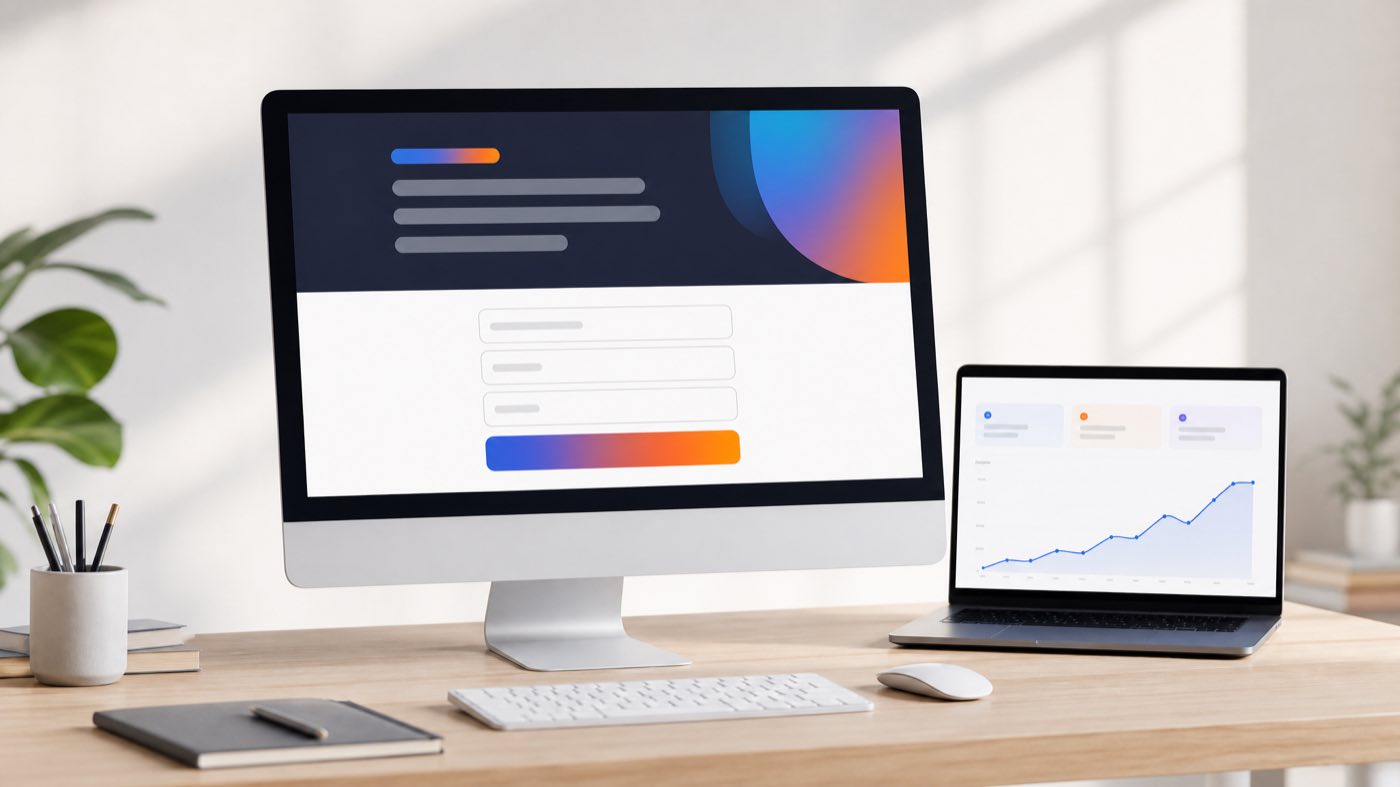
- A headline stating the specific outcome, matching the ad.
- One sentence of support — what you do, for whom, in what timeframe.
- The action — a call button, a short form, or a booking widget. One primary action, visually dominant.
- One trust element — a star rating with a count, years in business, a license number, or a recognisable certification.
Everything else can wait. A visitor who is ready should be able to convert without scrolling at all.
Strip the exits
A landing page is not a website. Remove the full navigation, the footer link farm, the blog links, the social icons. Every link that is not the conversion action is a way out of the page you paid to bring someone to.
Keep: the logo (unlinked or linked to the same page), the phone number, and legal links you are required to show. That is all.
Forms: fewer fields, better questions
Every additional field costs you submissions. Ask for what you genuinely need to make the next call useful, and nothing more.
- Name and phone are usually enough for a service business. Email if you will nurture.
- One qualifying question can be worth its cost — service needed, timeframe, zip code — because it makes the follow-up call much better.
- Never ask for an address, a budget or a "tell us about your project" essay on a first-touch form. Those belong in the phone call.
- Label the button with the outcome: "Get My Free Estimate," not "Submit."
- Make phone calls obvious. For urgent services most people will call, not fill in a form. A tap-to-call button that follows the visitor down the page usually out-converts the form.
Proof, in the order people need it
Trust is built in a specific sequence on a landing page:
- Reviews with numbers. "4.9 stars, 212 reviews" beats a curated testimonial, because it is verifiable.
- Real photos. Your team, your work, your premises. Stock photography reads as "could be anyone, anywhere," which is precisely the doubt you are trying to remove.
- Specific credentials. Licensed and insured with the number shown, manufacturer certifications, association memberships, years in business.
- Named testimonials with a location, ideally the suburb the visitor lives in.
- A guarantee or clear policy — warranty terms, no-obligation quote, price-match, free diagnosis.
Speed decides whether any of this is seen
You pay for the click whether or not the page loads. A slow landing page is a page charging you for impressions of a spinner — and because landing page experience factors into Quality Score, slowness raises your cost per click at the same time as it lowers conversions.
Aim for the page to be usable in under two seconds on mobile. Compress images, drop the sliders, remove every tracking script that is not earning its place, and do not build a paid landing page in a heavy page builder. The full argument is in what page speed costs a US small business.
Objections: answer them or lose to them
Every visitor has three or four reasons not to act, and they are boringly predictable per industry: price, timing, trust, and commitment. Answer them on the page.
- Price: a range, a starting-from, or an explicit "free estimate, no obligation."
- Timing: "we can usually be there today," "next available Thursday."
- Trust: license, insurance, reviews, years.
- Commitment: what happens after they submit — who calls, how fast, and what it costs. "We'll call within 15 minutes. No charge, no obligation."
A short FAQ block at the bottom handles the rest, and it costs nothing.
Test one thing at a time
The highest-impact tests, in rough order:
- Headline and offer.
- Form length.
- Call vs form as the primary action.
- Proof placement — reviews above the fold or below.
- Button copy.
Run one at a time, give it enough conversions to mean something, and keep the winner. Testing button colours before testing the offer is how teams spend a quarter learning nothing.
Then measure the right number
Not clicks, not conversion rate in isolation — cost per booked job, or cost per qualified lead if the sale takes longer. A page with a 4% conversion rate producing serious buyers beats a page at 9% producing tire-kickers, and only the downstream number tells you which one you have.
Track calls with a tracking number, tag form submissions, and follow them through to closed business. If you cannot connect ad spend to revenue, you are optimising in the dark.
What a landing page costs
Our US landing pages start at $169 — custom designed, fast, with tracking and a lead form wired up. That is one-time, not monthly. The US website cost guide shows what agencies typically charge for the equivalent, and if you need several pages for several ad groups, that is where a full site build makes more sense.
Frequently asked questions
Can I use my homepage as a landing page?
You can, and it will underperform a dedicated page in almost every case. A homepage serves many audiences; a landing page serves the one person who just clicked your ad. If you only ever build one dedicated page, build it for your most expensive keyword.
How many landing pages do I need?
One per distinct offer or service you advertise, and separate pages per city if you serve several and the intent differs. Start with your highest-spend ad group, prove the lift, then expand.
Should the form be short or should I qualify people?
Short, plus one qualifying question. Fewer fields raise submissions; the single question raises quality. Everything else belongs in the follow-up call.
Does landing page quality affect what I pay per click?
Yes. Google factors landing page experience into Quality Score, which influences both ad rank and cost per click. A faster, better-matched page can lower your cost per click while raising conversions — the effect compounds in your favour.
How fast should I follow up on a form submission?
Minutes, not hours. The person who filled in your form is filling in your competitors' forms in the same session. An instant automated acknowledgement plus a human call within fifteen minutes converts dramatically better than a next-day response.
The fastest fix available
Take your highest-spend ad group. Build one page that says back exactly what the ad promised, with one action, no navigation, proof above the fold, and a two-second load. Compare cost per booked job for a month.
If you would rather have it built, our landing pages start at $169 — message us on WhatsApp or at team@manastudio.in with the campaign you are running.