Video is now the default format for local discovery in America. People find restaurants, gyms, contractors, clinics and stores on Instagram and TikTok before they ever search, and the businesses posting weekly are visibly winning attention from the ones posting nothing.
The reason most US small businesses do not post weekly is not doubt. It is capacity. Filming, editing, captioning and publishing four videos a month is a part-time job, and a local agency charging $1,500 per produced video is not the answer either. AI-assisted production changed the arithmetic — this is how to use it without producing the obviously synthetic slop that customers scroll past.
What AI is genuinely good at, and what it is not
Good: editing, cutting, captioning, resizing to every aspect ratio, generating variations of the same ad, voiceover, background removal, colour and audio cleanup, and turning a long clip into six short ones. This is where the real time saving lives, and none of it makes your content look fake.
Bad, or at least risky: fully synthetic footage of your business, AI avatars pretending to be your staff, and generated images of food you do not serve or work you did not do. Local customers are choosing you partly because you are real. Fake footage undermines the exact thing that makes a local business worth choosing — and in the US, showing results or products you cannot substantiate is also an advertising problem, not just a taste problem.
The line that works: real footage, AI production. You shoot 60 seconds on a phone; AI does the tedious 90 minutes that follows.
The formats that actually perform for local businesses
1. The process video
Something being made, fixed, installed or transformed. A dish plated, a roof replaced in timelapse, a car diagnosed, a room re-styled. These hold attention because people genuinely want to see how things are done, and they demonstrate competence better than any claim.
2. The before-and-after
The single most reliable format in home services, auto, fitness and aesthetics. Keep conditions consistent, keep claims honest, and get written permission for anything involving a person.
3. The question answer
Twenty seconds answering something customers ask constantly. "Do I need a permit for this?" "How long does a filling take?" "What does a tune-up actually include?" These do double duty as social content and as the FAQ content on your website.
4. The team introduction
Who is going to show up at the house or greet them at the door. In service businesses this reduces the anxiety that stops people booking — especially anything where a stranger enters a home.
5. The customer story
The strongest conversion asset you have, and the one nobody films. A real customer, in their own words, saying what the problem was and what changed. Fifteen seconds is plenty.
How to shoot in five minutes a day
The businesses that keep this up have made it a habit, not a project:
- Shoot horizontally and vertically when you can, or shoot vertical and crop. Vertical is the primary format.
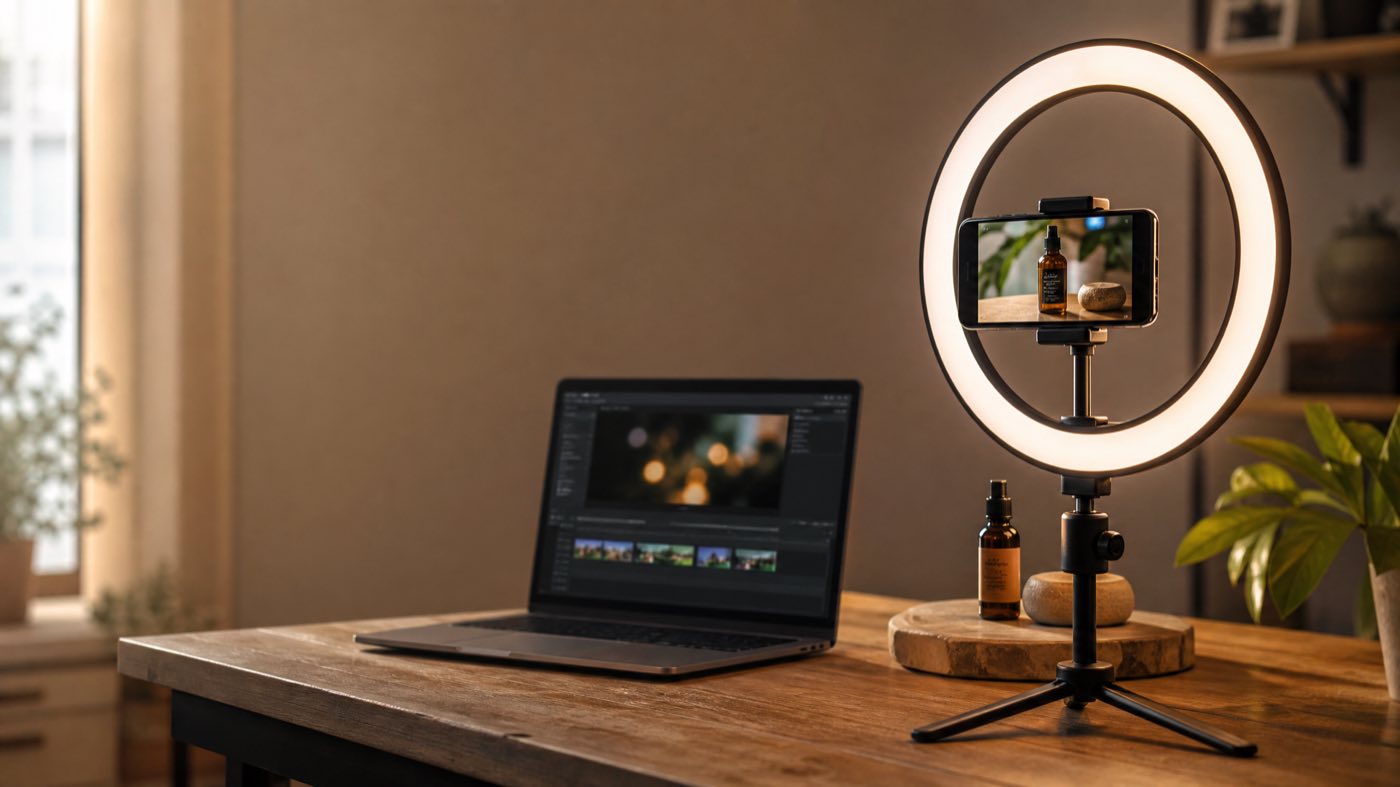
- Get the light right — face a window, or shoot outside. Lighting matters more than the camera and it is free.
- Audio matters more than image quality. Get close, avoid wind, use any cheap lapel mic for talking clips.
- Shoot more than you need. Thirty seconds of usable material gives an editor room; five seconds does not.
- Batch it. Ten minutes on a Friday capturing four moments beats trying to remember every day.
Then hand the raw clips off. That is the entire workflow.
Captions are not optional
A large share of social video is watched without sound. Burned-in captions — not the platform's auto-captions, which are unreliable — are the difference between a video that works and one that scrolls past. This is also the single most tedious editing task, and the one AI handles best.
Where to publish, and in what order
- Instagram Reels — the highest-value local platform for most US small businesses.
- TikTok — strongest for restaurants, fitness, beauty and anything visual with a younger customer base.
- YouTube Shorts — undervalued locally, and it feeds YouTube search, which is the second-largest search engine in the world.
- Google Business Profile — post video directly to your profile. Almost nobody does, and it sits exactly where people are deciding whether to call you. Mechanics in our Map Pack guide.
- Your website — a service page with a 30-second video of the work converts better than one without.
- Paid ads — the same footage cut into 3–4 variations gives you something to test.
One shoot, five destinations. That is where the leverage is.
Using video as paid creative
For Meta and TikTok ads, creative is the main lever — more than targeting, in most local accounts. Which means the ability to produce ten variations cheaply is a structural advantage.
What to vary: the first two seconds (the hook), the offer, the caption style, and the call to action. Run them, kill the losers quickly, put budget behind what works, and keep feeding new variations in — ad fatigue in a local audience arrives fast because the audience is small.
UGC-style creative — footage that looks like a real person filmed it on a phone, because it was — consistently outperforms polished commercial production for local businesses. That is convenient, because it is also cheaper.
What this costs
US video production agencies commonly charge $500–$2,500 per finished video, which puts weekly posting out of reach for most local businesses. Freelance editors are cheaper but need managing.
Our AI video service for US businesses is $29 per video, $199/month for a continuous content engine, or $149 for an ad creative pack of variations. You send phone footage; you get edited, captioned, correctly-sized videos back. The US video cost guide compares the options honestly, including when traditional production is genuinely the better buy.
Frequently asked questions
Will AI-edited video look fake?
Not if the footage is real. AI doing the cutting, captioning and resizing is invisible to the viewer. What looks fake is synthetic footage, AI avatars and stock clips pretending to be your business — and viewers spot those quickly.
How often should a small business post video?
Weekly, consistently, beats sporadic bursts. Two or three good videos a week is a strong cadence for most local businesses. What matters most is not stopping — the accounts that grow are the ones still posting in month six.
Do I need professional equipment?
A recent phone, good light and clean audio. That is genuinely it for local content. Spend on a cheap lapel mic before anything else; poor sound loses more viewers than poor picture.
Can I use AI-generated images of my products or results?
For your own products, results or premises — no. Show the real thing. Beyond the trust problem, US advertising rules treat unsubstantiated depictions of results as a compliance issue, and in regulated industries like aesthetics and healthcare the standards are stricter still. Use AI for editing, not for fabricating evidence.
What should my first five videos be?
A team introduction, one process video of your core service, two answers to questions customers ask constantly, and one customer story. That set covers discovery, trust and conversion, and you can film all of it in an afternoon.
Start this week
Film four moments on your phone this week — the work being done, one common question answered, one customer if they are willing, and your team. Ten minutes total. Then get them edited and captioned properly.
If the editing is the part that stops you, that is what we do — $29 per video or $199/month. Send us a clip on WhatsApp or at team@manastudio.in and we will send back the finished version so you can see the quality before deciding anything.