Run the numbers on your last month of third-party delivery orders. Take the gross, subtract the commission, subtract the promotion you ran because the app suggested it, subtract the refunds you did not authorise. Now look at what is left and compare it to your food cost.
A lot of American restaurant owners discover the same thing when they do this exercise: the delivery channel is running at close to break-even, or below it, and it has been for a while. Meanwhile the customers it brought in belong to the app, not to the restaurant.
This is not an argument for deleting your DoorDash listing tomorrow. It is an argument for owning a channel alongside it, because the economics of the two are not close.
What the marketplace actually costs you
Third-party marketplaces in the US typically take somewhere between 15% and 30% of the order for delivery, plus payment processing, plus whatever you spend on in-app promotion to stay visible. The exact rate depends on the tier you signed up for — and the higher tiers exist precisely because visibility in the app is pay-to-play.
The commission is the visible cost. The invisible ones matter more:
- You do not get the customer. No name, no email, no phone, no order history you can use. You cannot text them a Tuesday offer because they are not yours to text.
- You compete on a shelf you do not own. Your listing sits beside every competitor within three miles, sorted by an algorithm that responds to paid placement.
- Price inflation drives people away. Menu markups plus service fees plus delivery fees make a $14 dish cost $24, and the customer blames the restaurant, not the app.
- Service failures land on you. A cold delivery driven by a driver you did not hire becomes a one-star review of your food.
What direct ordering costs
Your own ordering page costs a one-time build plus payment processing — the standard card rate, and nothing else. There is no per-order commission going to a third party, and every customer who orders becomes a record you own: name, phone, email, what they ordered, when.
The break-even maths is straightforward. Work out your average monthly commission spend, then compare it to a one-time build cost. For most restaurants doing meaningful delivery volume, an owned ordering system pays for itself in weeks, not years — and everything after that is margin that used to leave the building.
The honest case for keeping the apps
Do not let anyone sell you the fantasy that you can switch off marketplaces and keep the volume. You cannot, at least not at first, because the apps genuinely do one thing you cannot replicate on day one: discovery. A person who does not know your restaurant exists is browsing the app, not searching your name.
The right model is a split:
- Marketplaces are your acquisition channel. Accept the commission as a customer acquisition cost for people who have never heard of you.
- Your own site is your retention channel. Every one of those customers should be nudged toward ordering direct next time — and once they do, you never pay commission on them again.
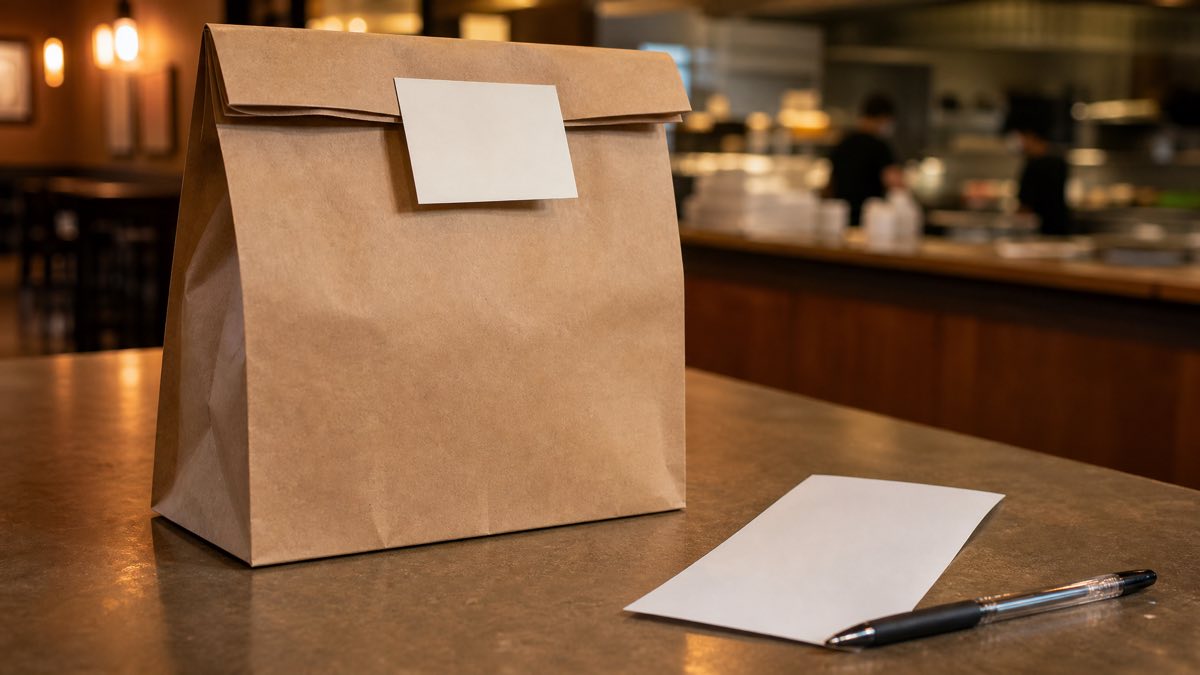
The nudge is not complicated. An insert in every bag: "Order direct next time and get 15% off — [yoursite].com." You are offering 15% instead of paying 25%, you win either way, and you get the customer's details.
What your direct ordering setup actually needs
Restaurants often over-build this and stall. The list is shorter than you think:
- A menu that loads in under two seconds on a phone. Photos of every popular dish, compressed properly. A PDF menu is not a menu — it is a document that people pinch, zoom and abandon.
- Ordering with pickup and delivery options, and a clear delivery radius so you are not accepting orders you cannot fulfil.
- Card payment plus Apple Pay and Google Pay. Mobile wallets meaningfully reduce abandoned carts because nobody wants to type a card number one-handed.
- Scheduled ordering. Lunch rushes are made of orders placed at 10:40am.
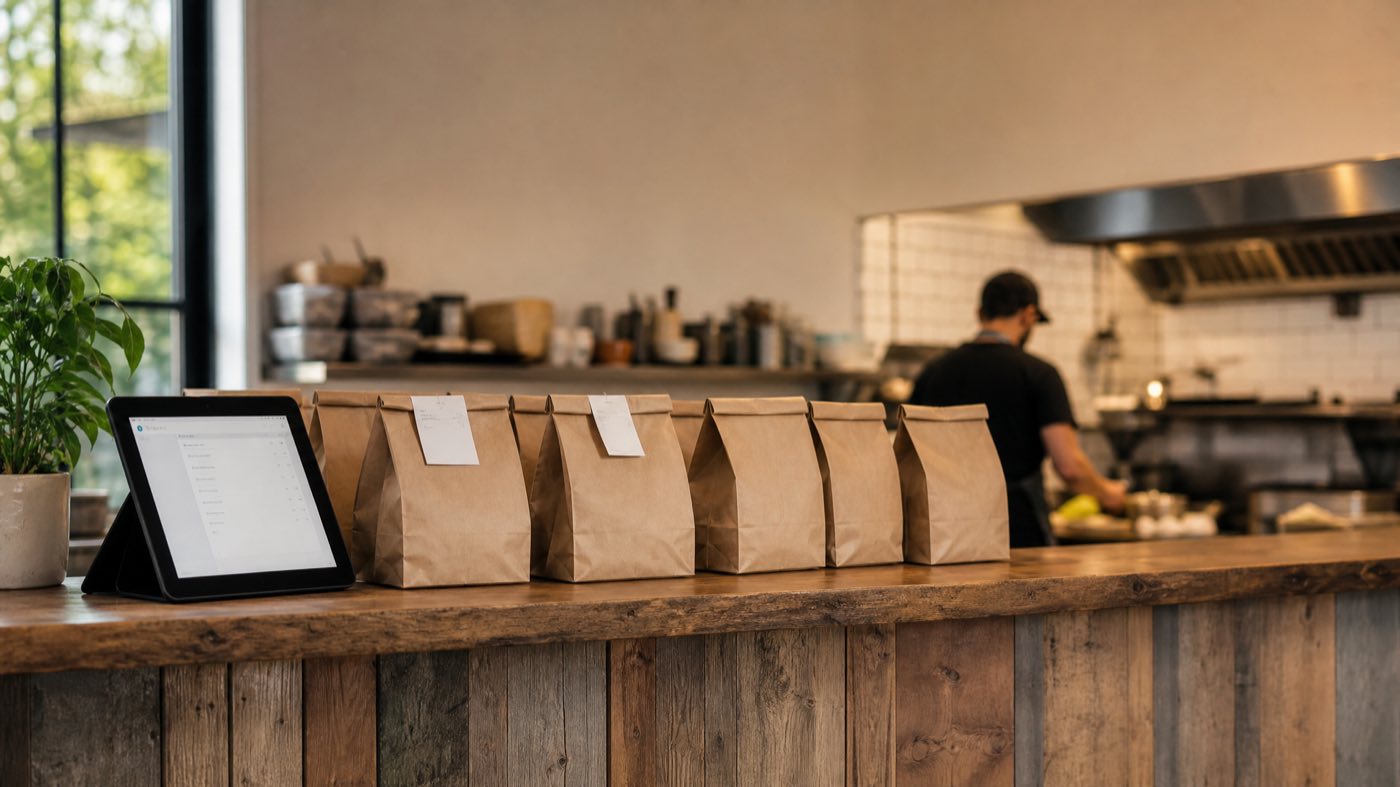
- Order notifications that reach the kitchen reliably — a tablet, a printer, whatever your staff will actually watch during service.
- Catering and large-order enquiries. High margin, low effort, and almost always missing.
- Local delivery, either your own driver or one of the on-demand courier services that charges a flat fee per delivery rather than a percentage of the order.
Getting found without the app
Owning the ordering flow only helps if people arrive at it. Three things bring them:
Google Business Profile
Put your ordering link directly on the profile. When someone searches your restaurant name — which is the majority of your inbound search traffic — the "Order" button should point at your site, not the marketplace. Keep the menu current, post photos of real food weekly, and reply to reviews. For the full mechanics, see our Google Map Pack guide.
Local search
"Thai food near me," "best tacos in [city]," "Indian restaurant open now." These are the searches that fill tables, and they are winnable with a proper website plus an active profile. That is what local SEO at $299/month is for.
Short-form video
Food is the single most effective category on Instagram and TikTok, and it is not close. Twenty seconds of a dish being plated, posted on a Friday afternoon, reliably moves that evening's covers. Most owners skip it because filming and editing weekly is genuinely hard during service — which is what our AI video service exists for, at $29 per video or $199/month for a steady stream.
Turning one-time orders into regulars
The customer list you build from direct ordering is the actual asset. What to do with it:
- A text to your list on a slow Tuesday moves more covers than a week of social posting. Use it sparingly — twice a month, real offers, easy opt-out.
- Order history-based offers. The person who orders biryani every Friday gets a different message from the person who came once for lunch.
- A simple loyalty mechanic — tenth order free, birthday offer. It does not need an app.
- Win-backs. A customer who ordered four times and then stopped for two months is worth one message. This is the highest-return email most restaurants never send.
What it costs to set up
A restaurant website with full direct ordering built as a custom, fast site starts at $499 with us, or from $1,249 with a full e-commerce and catering setup — see the US e-commerce cost guide for what the tiers include and what US agencies charge for the same work. Details of the build are on our restaurant websites page.
Compare that to a monthly ordering platform charging a percentage or a per-order fee forever. The subscription model is fine while volume is small and expensive the moment it is not — the same trade-off we cover in website builders vs custom.
Frequently asked questions
Will I lose orders if I stay on the marketplaces?
No — keep them. The goal is not to leave, it is to stop paying commission on customers who already know you. Treat the apps as paid acquisition and your own site as the place repeat customers land.
How do I handle delivery without DoorDash drivers?
Either hire your own driver for peak hours if your volume supports it, or use an on-demand courier service that charges a flat fee per delivery instead of a percentage of the order. Many restaurants also find that once ordering is direct, a healthy share of customers choose pickup — which costs you nothing.
Is a restaurant app worth building?
Only once you have real repeat volume through your own website and a reason for people to keep it installed — subscriptions, loyalty, reordering in two taps. Most restaurants are better served by a fast mobile site first. If it does make sense, app costs start at $1,049.
How do I get customers to switch from the app to my site?
Put an offer in every delivery bag, print it on the receipt, and make the discount smaller than the commission you are paying. Announce it on your profile and social. It takes a few months, and it compounds, because every switched customer stays switched.
What is the single biggest mistake restaurants make online?
A PDF menu, or no menu at all. If a hungry person cannot read your menu on a phone in five seconds, they order from whoever they can. Photos of your actual food, plain HTML, fast loading.
Do this first
Add up last month's commission. That number is your budget, and it is almost certainly larger than what a direct ordering site costs to build once.
When you want it built — menu, ordering, payments, catering enquiries, and the local SEO to bring people to it — see what we build for US restaurants, or message us on WhatsApp or at team@manastudio.in.