
A dental practice does not have a marketing problem. It has a schedule problem — specifically, holes in next week's schedule that were supposed to be filled by patients who searched, found somebody else, and booked there instead.
The gap between a busy practice and a quiet one in the same zip code is rarely clinical skill. It is almost always four things: who shows up in the map results, how many recent reviews they have, whether a new patient can book without calling, and whether the front desk answers the phone. This is how to fix all four.
Understand what a new patient is worth before you spend a dollar
Every marketing decision gets easier once you know two numbers for your own practice: the average value of a new patient in their first year, and your current cost per new patient. Most general practices in the US find the first number lands somewhere between several hundred and a couple of thousand dollars depending on case mix and insurance participation — and it goes up sharply if you do implants, ortho or cosmetic work.
Once you know it, a marketing spend stops being a leap of faith and becomes arithmetic. If a new patient is worth $900 in year one and you are paying $180 to acquire one, you do not have a budget problem, you have a scaling opportunity. Practices that do not track this end up cancelling the thing that was working because it "felt expensive."
1. The local map results decide most of it
"Dentist near me," "emergency dentist," "dentist open Saturday" — these searches show a map with three practices before anything else. Being in that block is worth more than any other single asset you can build online.
What moves it, in order of leverage:
- Primary category set to "Dentist" — then secondaries for the specialties you want cases in: Cosmetic Dentist, Pediatric Dentist, Dental Implants Periodontist, Orthodontist. Practices that leave a vague primary category lose to practices that do not.
- Services listed individually — cleanings, crowns, root canals, implants, Invisalign, emergency care, whitening. Each entry is a matching surface for a different search.
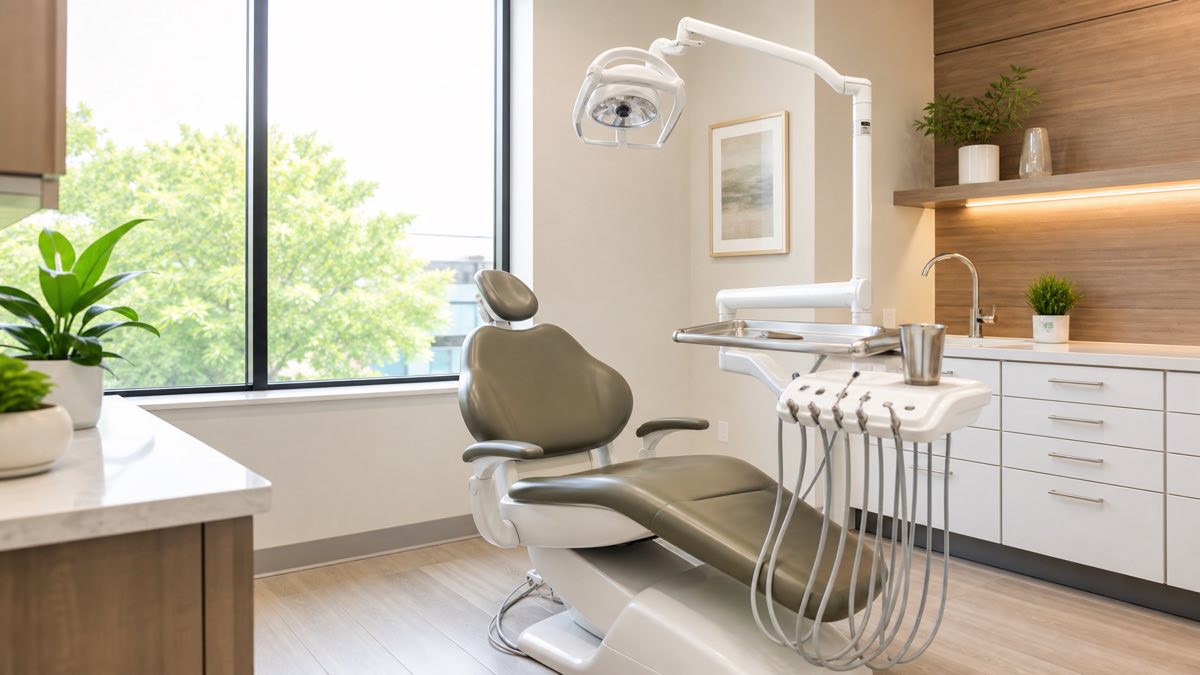
- Real photos, refreshed — the operatories, the sterilization area, the team, the parking. Not stock. New patients are deciding whether your office looks clean and whether they will feel comfortable, and they decide it from photos.
- Accurate hours, including early mornings and Saturdays if you offer them. Availability outside working hours is a genuine competitive advantage in dentistry and most practices bury it.
- Insurance information stated plainly. "Do you take my insurance?" is the single most common reason a prospective patient does not call. Answer it before they ask.
The full mechanics of local ranking — including why distance from the searcher caps what is possible — are in our guide on winning the Google Map Pack.
2. Reviews are the deciding factor in dentistry more than almost any industry
People are anxious about dentists. They read reviews carefully, and they read the bad ones on purpose. Two practices with 4.8 stars are not equal if one has 30 reviews from 2023 and the other has 300 with a dozen from last month.
A review system that works in a dental office:
- Ask at checkout, in person, by name. "Would you mind leaving us a quick review? I'll text you the link right now." The person who just had a painless cleaning is the most willing they will ever be.
- Send the link by text immediately — automate it from your practice management software. The gap between asking and sending is where reviews die.
- Do not ask patients who just had a difficult visit. Obvious, frequently ignored.
- Reply to everything, and be extremely careful about HIPAA. This matters more in healthcare than anywhere else: never confirm someone was a patient, never reference their treatment, never argue clinical details in public. A safe template — "Thank you for the feedback. We take concerns seriously and would like to discuss this directly. Please call our office manager at [number]." That is it.
- Aim for consistency, not bursts. Ten reviews a month forever beats a hundred in one quarter and silence after.
3. Online booking, or you lose the evening searchers
Here is the pattern in almost every practice's analytics: a spike in website traffic between 8pm and 11pm, and a phone that does not ring because the office closed at five. Those people are shopping for a dentist right now and every one of them without a booking option is a lead handed to the practice down the road that has one.
You do not need a full patient portal. You need a request-appointment flow that captures name, phone, insurance, whether they are a new patient, and preferred times — and that lands in a place your front desk actually checks first thing in the morning. Practices that add this typically find a meaningful share of new-patient bookings come in outside office hours.
4. The website has one job: make an anxious person feel safe enough to book
Dental websites fail in a predictable way. They lead with the practice's history and a stock photo of a model with unnaturally white teeth, and they bury the four things a new patient actually wants:
- Do you take my insurance? List the plans. Put it in the navigation.
- What will this cost? Even ranges and financing options beat silence. Cost anxiety is the number one reason people delay dental care in the US.
- Are you accepting new patients, and how soon can I be seen?
- What is it like there? Real photos of your actual office and your actual team. Faces matter — patients are choosing a person, not a building.
Add to that: a dedicated page for each high-value service (implants, Invisalign, emergency, cosmetic, pediatric), because those are separate searches with separate intent and a single "Services" page cannot rank for all of them. Then make it fast — most of your traffic is on a phone, and a slow site quietly kills conversions before anyone reads a word. We covered exactly what that costs in what page speed costs a US small business.
Our dental practice websites are built around this structure, and pricing starts at $499 for a full practice site — the complete US website cost breakdown shows what agencies typically charge for the same scope.
5. Emergency dentistry is the most underused opportunity in the practice
Someone with a broken tooth at 7pm on a Friday is not comparison shopping. They search, they call the first practice that looks open and reachable, and they become a patient for years if you treat them well.
Most practices have nothing for this searcher. Build it: a dedicated emergency page, "emergency dentist" in your services, after-hours contact instructions that are actually true, and a phone number that reaches a human or a service rather than voicemail. It is a small amount of work for a category of patient that competitors are ignoring.
6. Stop the leak at the front desk
The most expensive marketing failure in dentistry has nothing to do with marketing. It is the unanswered phone. A practice can spend thousands driving calls and then miss a quarter of them at lunch, during huddles, and after five — and never know, because a missed call leaves no record anyone reviews.
Three fixes, all cheap:
- Track calls. Use a tracking number so you know how many came in, how many were answered, and when they were missed.
- Call back every missed number the same day. Not tomorrow. The patient books elsewhere by tomorrow.
- Have a script for the price question. "How much is a crown?" answered with "It depends" ends the call. Answered with a range, an insurance check offer and an appointment slot, it books.
What a sensible monthly program looks like
For a single-location general practice: a properly built website, a fully optimised Google Business Profile, an automated review system, service and location pages, and ongoing local SEO. US dental marketing agencies commonly charge $2,000–$5,000 a month for this, often with a long contract attached.
Our local SEO for US practices runs $299/month, growth SEO $499/month, and a one-time audit at $129 if you want a diagnosis before committing to anything. If you want to see what actual patient-facing video looks like for a practice — team introductions, procedure explainers, patient FAQ shorts — that is our AI video service at $29 per video.
Frequently asked questions
Should a dental practice run Google Ads or invest in SEO?
Both, in that order of urgency. Ads buy you patients this month while SEO is still maturing; SEO gives you patients that do not stop when you stop paying. If the budget only covers one, start with ads for high-value procedures and emergency terms, and build the SEO foundation underneath so you can eventually reduce ad dependence.
How do I respond to a negative review without violating HIPAA?
Never acknowledge the person was a patient and never discuss any clinical detail. Respond generically — thank them for the feedback, state that you take concerns seriously, and invite them to call the office directly. Move the conversation offline immediately. Every additional public detail increases your exposure.
How many Google reviews does a dental practice need?
Enough to match the top three practices showing in your local results, then more recent ones than they have. In most US suburbs that is 100–300; in dense metros it can be far higher. What matters as much as volume is that new ones keep arriving.
Is it worth having separate pages for implants, Invisalign and emergency care?
Yes, and it is one of the highest-return things you can do. Those are separate searches with separate intent and much higher case value than a cleaning. A single combined services page cannot rank well for any of them.
How long before a new dental website and SEO produce patients?
A better website starts converting your existing traffic immediately. Profile and review improvements typically show in four to eight weeks. Competitive local rankings for terms like "dentist [city]" usually take three to six months. Anyone promising faster in a competitive US metro is not being straight with you.
Start here
This week: set your primary category correctly, list every service, publish your insurance list on the website, and text a review link to your last thirty patients. That costs nothing and it is where most of the movement comes from.
When you want the site, the service pages, the booking flow and the local SEO built properly, see what we build for US dental practices or message us on WhatsApp or team@manastudio.in. Tell us your city and your case mix and we will tell you what we would do first.