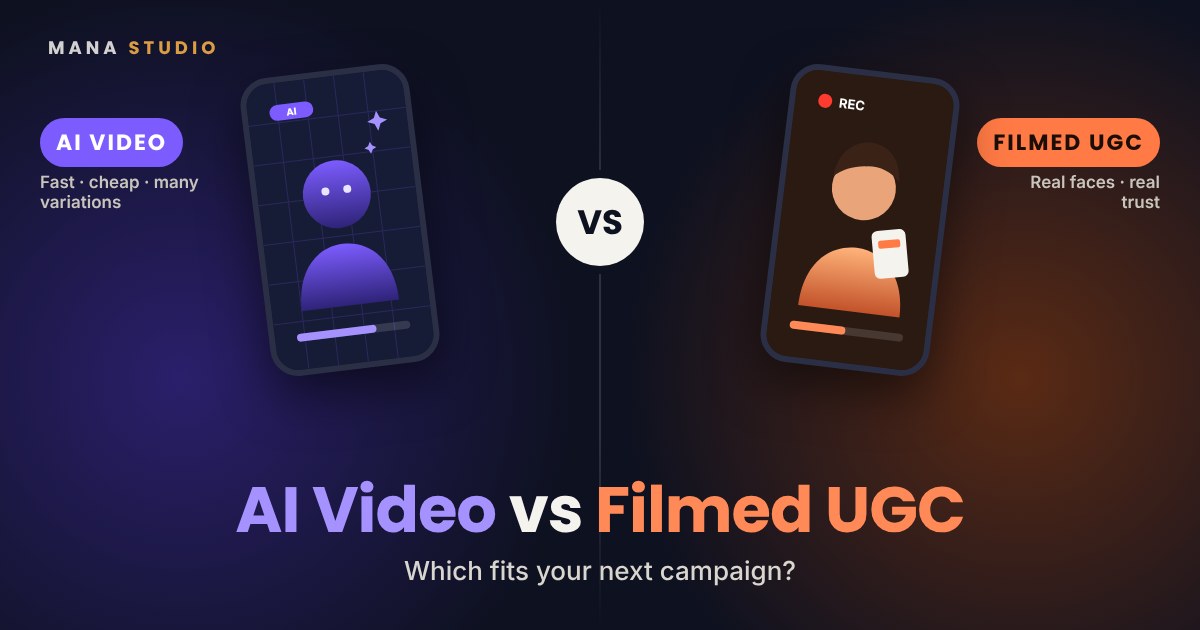
The short answer: use AI video when you need many ad variations fast, for testing hooks, angles and offers on a small budget. Use filmed UGC when the ad depends on trust: a real face, a real product in real hands, a real experience. Most brands that scale profitably in 2026 use both. AI finds the winning message cheaply, and a real creator films the version that gets the big budget.
That is the whole decision in one paragraph. The rest of this guide shows you how to apply it to your own campaign: what each option costs, where each one wins, the labelling rules you now have to follow, and a four-question checklist to settle it.

AI video vs filmed UGC at a glance
AI video (AI UGC)Filmed UGC (real creator)
Cost per video
Roughly $1 to $20 in tool costs, plus your team's time
Roughly $100 to $500, plus product and usage rights
Turnaround
Hours
Days to weeks
Variations
Dozens per brief
A handful per creator
Trust
Lower, especially if it looks polished or "off"
Highest, because the person and the experience are real
Organic reach
None. AI presenters have no audience
Can run from the creator's own handle
Labelling
Often required (see below)
Standard #ad disclosure only
Best for
Testing hooks, scripts, offers and languages
Testimonials, demos and scaling proven winners
When AI video is the right choice for your campaign
AI video earns its place when the bottleneck is volume, not trust. Choose it when:
- You don't know your winning hook yet. Ad platforms reward fresh creative, and the best way to find a winner is to test many. A head-to-head Meta test by Segwise found AI UGC was 5 to 10 times cheaper per test variant.
- Your budget is small. If one creator video costs as much as your first week of ad spend, AI lets you spend the money on reach instead of production.
- You need several languages. One script can become Telugu, Hindi and English versions without three shoots.
- The product is explained rather than felt. Software, services, courses and offers work well with a clear presenter and on-screen text.
- Your ads are wearing out fast. When performance drops every couple of weeks, AI lets you refresh creative without starting a new shoot each time.
One warning. Studio-polished AI tends to underperform, because viewers read it as a brand ad pretending to be a creator. Keep AI videos simple, phone-shot in style, and specific.
When filmed UGC will outperform AI
Real creators still win whenever the viewer needs to believe a person actually used the product:
- Skincare, beauty, food and fitness. These are emotional, results-led categories. In the same Segwise test, human creators converted better than AI in skincare.
- Physical products people want to see handled. Texture, size, fit and unboxing are hard to fake convincingly.
- Testimonials. A fabricated customer story is a trust problem and, in many markets, a legal one. If the ad says "this worked for me", a real person must say it.
- Creator-handle ads. TikTok Spark Ads and Meta partnership ads run from a creator's real account. As Oakgen notes, AI presenters have no handle, followers or comment history to borrow.
- Local businesses. For a clinic, restaurant or showroom in Hyderabad or Warangal, your actual staff and space are the proof. AI can't film your shop.
How much does AI video vs filmed UGC cost in 2026?
Published 2026 figures put a creator UGC video at about $150 to $500 per asset, before usage rights for paid ads. An October 2026 comparison by Knowlify priced a short AI avatar render at about $1 to $12 on published plans.
Those numbers flatter AI more than they should. The real cost of AI video is your team's time: writing the script, generating takes, rejecting the strange ones and editing. The real cost of creators is coordination: finding them, shipping product, briefing and waiting.
The fair comparison is cost per usable ad, not cost per render. Run a small batch of each, count the hours, and divide by the number of ads that passed review.
In India, creator rates vary widely by follower count and city. Always ask for the usage-rights fee separately. A cheap video you can only post organically is not cheap if you planned to run it as an ad.
The hybrid approach that gets the best ROAS
You don't have to choose one forever. The workflow we recommend to clients runs in four steps:
- Test with AI. Make 10 to 20 AI variations of hooks and angles. Run them on a small budget for a week.
- Pick the winners. Keep the two or three with the best thumb-stop rate and cost per result.
- Film the winners with real creators. Brief the creator with the exact hook and script that won, and let them say it in their own words.
- Scale the filmed version. Put the larger budget behind the human ad, and keep using AI to test the next round of ideas.
This way, AI pays for the learning and creators get paid only for ideas you already know work.
AI ad disclosure rules on Meta, YouTube and TikTok
Labelling is no longer optional in many cases, so plan for it before you launch:
- TikTok: since 21 July 2026, ads with realistic AI-generated content need a disclosure label before they can run.
- YouTube: uploads with realistic synthetic people or scenes require creator disclosure.
- Meta: ads made with Meta's own generative tools may be labelled automatically. Strict self-disclosure applies mainly to political and social-issue ads.
- India: the amended IT Rules, in force since 20 February 2026, require platforms to label synthetic content, and ASCI issued draft guidelines on labelling AI advertising in May 2026.
A label won't save an ad that misleads. Never use an AI person to give a customer testimonial, and never show product results the product can't deliver.

one should you choose? A 4-question checklist
- Does the ad claim a personal experience? If yes, film it with a real person.
- Do you already know your winning hook? If not, test with AI first.
- Does the viewer need to see the product handled? If yes, filmed UGC.
- Is your budget under the cost of three creator videos? If yes, start with AI and film once you have a winner.
Two or more answers pointing to filmed UGC means a real creator is worth the money. Otherwise, start with AI.
Frequently asked questions
Is AI UGC as effective as real UGC?
For testing, often yes, because it is far cheaper to produce many variants. For trust-heavy categories like skincare, real creators still tend to convert better. Most brands get the best results using AI to test and creators to scale.
Is AI video cheaper than hiring a UGC creator?
Per render, yes, by a wide margin. Per usable ad, the gap narrows once you count your team's time on scripting, generating and editing. Compare the cost per ad that actually launches.
Do I have to label AI-generated video ads?
On TikTok, realistic AI ad content needs a disclosure label. YouTube requires disclosure for realistic synthetic content. In India, the 2026 IT Rules require platforms to label synthetic media. When in doubt, label it.
Can AI UGC be used for testimonials?
No. A testimonial must come from a real person who used the product. An AI presenter can explain features or an offer, but it should never claim a personal result.
Which works better for small businesses in India?
Start with AI to find a message that works on a small budget, then film one real version with your staff or a local creator. For local businesses, real faces and real premises usually build more trust than any avatar.
Not sure which fits your next campaign? We plan, script and produce both AI video and creator-led ads, and we test them against each other on your budget before you scale. See our social media marketing plans or message us on WhatsApp at +91 86885 48048.
{ "@context": "https://schema.org", "@graph": [ { "@type": "BlogPosting", "@id": "https://manastudio.in/article/ai-video-vs-filmed-ugc#article", "headline": "AI Video vs Filmed UGC: Which Fits Your Next Campaign?", "description": "AI video or filmed UGC? Compare cost, speed, trust and 2026 AI ad labelling rules, plus a 4-question checklist to choose the right fit for your campaign.", "image": [ "https://warranty-vault.s3.ap-south-1.amazonaws.com/manastudio/blog/ai-video-vs-filmed-ugc.jpg" ], "author": { "@type": "Person", "name": "Vamshikrishna", "url": "https://manastudio.in" }, "publisher": { "@type": "Organization", "name": "Mana Studio", "url": "https://manastudio.in" }, "datePublished": "2026-10-28", "dateModified": "2026-10-28", "mainEntityOfPage": "https://manastudio.in/article/ai-video-vs-filmed-ugc", "inLanguage": "en-IN", "wordCount": 1343, "keywords": "AI video vs UGC, AI UGC vs real UGC, AI UGC ads, UGC video ads cost, AI ad disclosure rules" }, { "@type": "FAQPage", "@id": "https://manastudio.in/article/ai-video-vs-filmed-ugc#faq", "mainEntity": [ { "@type": "Question", "name": "Is AI UGC as effective as real UGC?", "acceptedAnswer": { "@type": "Answer", "text": "For testing, often yes, because it is far cheaper to produce many variants. For trust-heavy categories like skincare, real creators still tend to convert better. Most brands get the best results using AI to test and creators to scale." } }, { "@type": "Question", "name": "Is AI video cheaper than hiring a UGC creator?", "acceptedAnswer": { "@type": "Answer", "text": "Per render, yes, by a wide margin. Per usable ad, the gap narrows once you count your team's time on scripting, generating and editing. Compare the cost per ad that actually launches." } }, { "@type": "Question", "name": "Do I have to label AI-generated video ads?", "acceptedAnswer": { "@type": "Answer", "text": "On TikTok, realistic AI ad content needs a disclosure label. YouTube requires disclosure for realistic synthetic content. In India, the 2026 IT Rules require platforms to label synthetic media. When in doubt, label it." } }, { "@type": "Question", "name": "Can AI UGC be used for testimonials?", "acceptedAnswer": { "@type": "Answer", "text": "No. A testimonial must come from a real person who used the product. An AI presenter can explain features or an offer, but it should never claim a personal result." } }, { "@type": "Question", "name": "Which works better for small businesses in India?", "acceptedAnswer": { "@type": "Answer", "text": "Start with AI to find a message that works on a small budget, then film one real version with your staff or a local creator. For local businesses, real faces and real premises usually build more trust than any avatar." } } ] }, { "@type": "BreadcrumbList", "itemListElement": [ { "@type": "ListItem", "position": 1, "name": "Home", "item": "https://manastudio.in" }, { "@type": "ListItem", "position": 2, "name": "Articles", "item": "https://manastudio.in/article" }, { "@type": "ListItem", "position": 3, "name": "AI Video vs Filmed UGC: Which Fits Your Next Campaign?", "item": "https://manastudio.in/article/ai-video-vs-filmed-ugc" } ] } ] }